Contemporary Art Explorer
Select an artwork below to deconstruct its meaning, medium, and the specific myth it challenges.
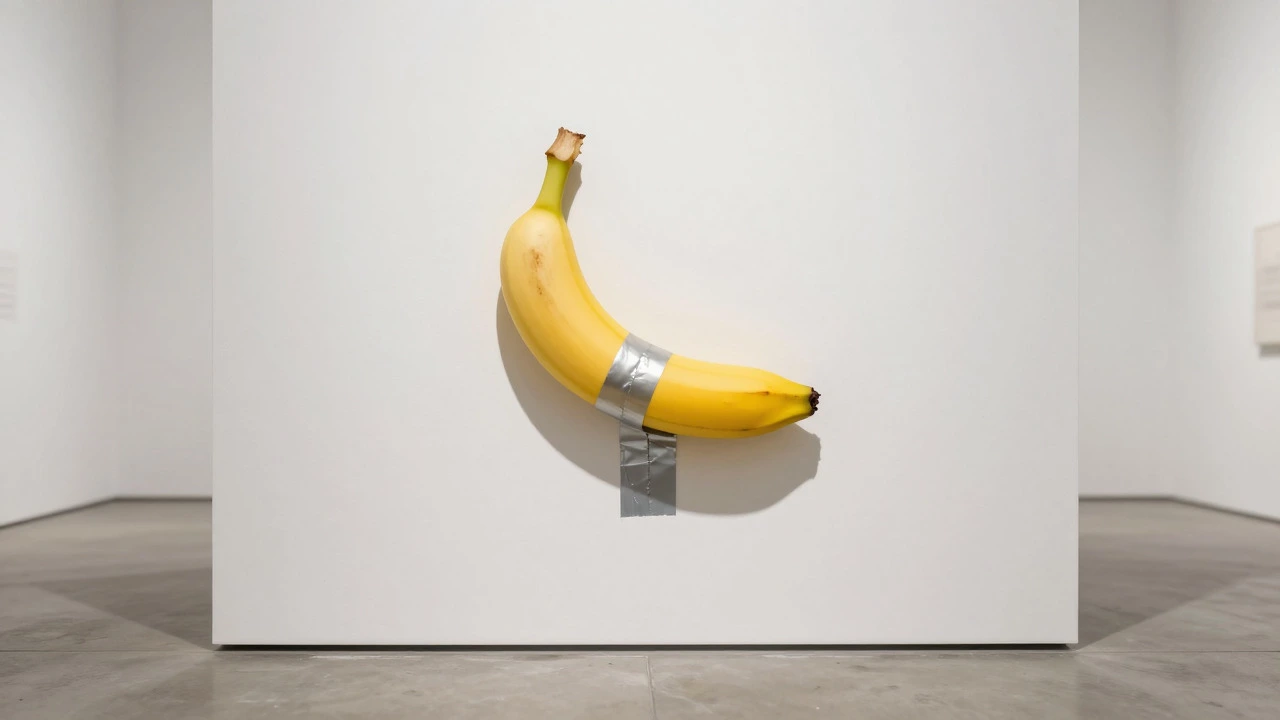
Comedian
Maurizio Cattelan (2019)
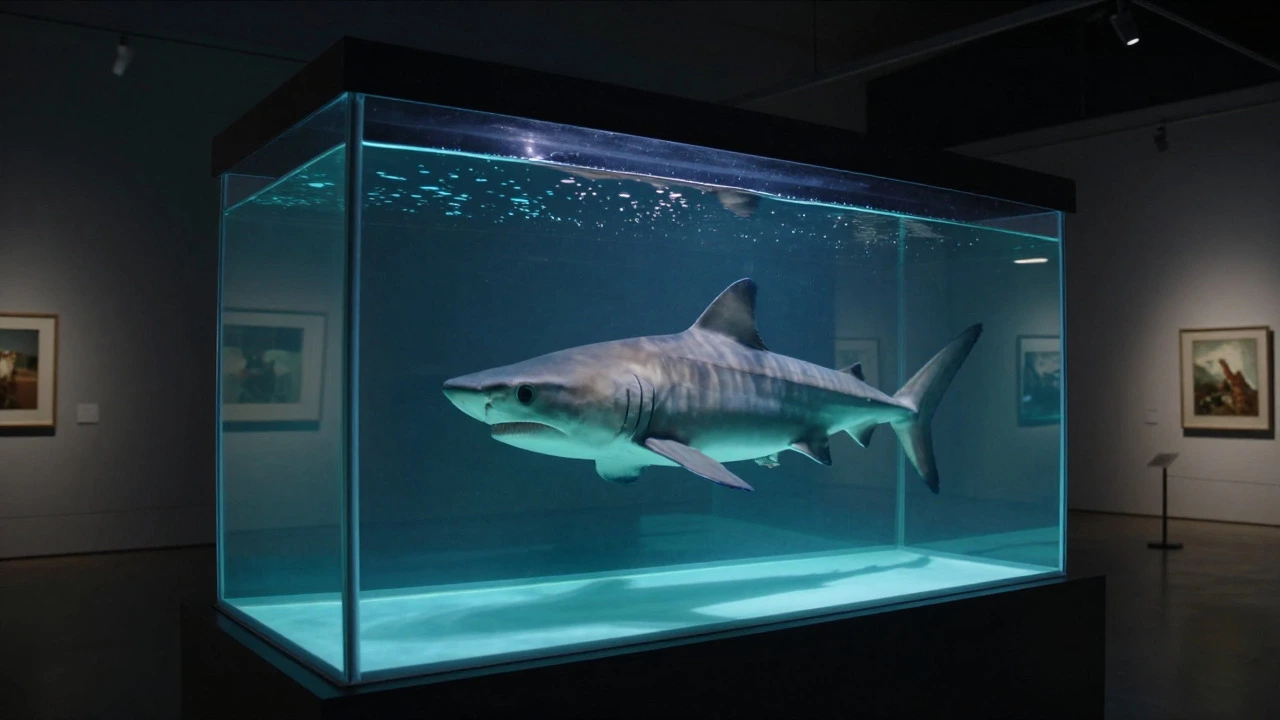
Conceptual ReadymadeShark in Formaldehyde
Damien Hirst (1991)
Installation MortalityMy Bed
Tracey Emin (1998)
Confessional Found ObjectThe Medium
Core Concept
Select a work above to analyze its artistic significance.
You walk into a gallery and see a banana taped to the wall. You look around, confused. Is this a joke? A mistake? Or is it contemporary art, defined as art produced in the present era, characterized by diverse materials, concepts, and global perspectives? If you’ve ever stood before a piece that made you question what art even is, you’re not alone. Contemporary art often challenges our expectations, pushing boundaries beyond traditional painting or sculpture.
To understand what constitutes an example of contemporary art, we need to look past the confusion and examine the intent, medium, and context. Unlike earlier movements with strict rules, contemporary art is less about how something looks and more about what it says. It reflects the world we live in right now-our politics, technology, identity, and environment.
Defining the Boundaries: What Makes Art "Contemporary"?
The term "contemporary" simply means "current" or "existing at the same time." In the art world, it generally refers to work created from the late 1960s or early 1970s to the present day. This distinguishes it from modern art, which is a period spanning roughly from the 1860s to the 1970s, focusing on breaking away from classical traditions. While modern artists like Picasso or Mondrian were experimenting with form and color, contemporary artists are experimenting with ideas and social issues.
There is no single style that defines contemporary art. Instead, it is a catch-all term for a wide range of practices. Key characteristics include:
- Concept over technique: The idea behind the work is often more important than the technical skill required to make it.
- Diverse media: Artists use video, performance, digital tools, found objects, and installation spaces, not just canvas and paint.
- Global perspective: It includes voices from all over the world, not just Europe and North America.
- Social engagement: Many works address current events, climate change, gender identity, and political unrest.
When you ask for an example of contemporary art, you aren’t looking for a specific look; you are looking for a mindset that engages with the now.
Iconic Examples of Contemporary Art
To make this concrete, let’s look at three famous pieces that perfectly illustrate the diversity and conceptual nature of contemporary art. These works are widely recognized and frequently cited in museums and textbooks.
1. "Comedian" by Maurizio Cattelan (2019)
If you have seen memes of a banana taped to a wall, you know this piece. Created by Italian artist Maurizio Cattelan, this work consists of a real Cavendish banana attached to the wall with duct tape. It was sold for $120,000 at Sotheby’s. Why is this art? Because it questions value, perception, and the art market itself. The banana is perishable; if it rots, it gets replaced. The artwork isn’t the fruit; it’s the concept of assigning high value to something mundane.
2. "The Physical Impossibility of Death in the Mind of Someone Living" by Damien Hirst (1991)
This is perhaps the most recognizable example of installation art, which is an artistic genre of three-dimensional works that are often site-specific and designed to transform the perception of a space. British artist Damien Hirst placed a tiger shark preserved in formaldehyde inside a glass vitrine. The title suggests a philosophical meditation on mortality. By confronting viewers with death in such a visceral way, Hirst forces us to think about our own existence. It is shocking, yes, but it is also deeply conceptual.
3. "My Bed" by Tracey Emin (1998)
British artist Tracey Emin presented her unmade bed, surrounded by personal debris like stained underwear, empty wine bottles, and cigarette packets. This is a prime example of confessional art, which uses personal trauma and intimate details to explore universal human experiences. It won the Turner Prize nomination and sparked huge debate. Is it art if it’s just someone’s messy room? Emin argues that the emotional truth of depression and heartbreak makes it art. It breaks the barrier between private life and public display.
| Artwork | Artist | Medium | Core Concept |
|---|---|---|---|
| "Comedian" | Maurizio Cattelan | Fruit, Duct Tape | Value and Perception |
| "Shark in Formaldehyde" | Damien Hirst | Preserved Animal, Glass | Mortality and Existence |
| "My Bed" | Tracey Emin | Found Objects, Installation | Vulnerability and Identity |
Common Misconceptions About Contemporary Art
One of the biggest hurdles for new viewers is the feeling of fraudulence. "My kid could do that," is a common reaction. But here is the thing: in contemporary art, execution is often secondary to intention. Let’s clear up some myths.
Myth 1: It has to be beautiful. Beauty is subjective and often irrelevant. Art can be ugly, disturbing, or boring if it serves the concept. Think of Marina Abramović, a pioneer of performance art, where the artist's body becomes the medium, often involving endurance and interaction with the audience. Her work "Rhythm 0" involved her standing still while the audience could do anything to her using 72 objects. It wasn't pretty; it was a terrifying exploration of human nature.
Myth 2: It’s always abstract. While abstraction exists, much contemporary art is hyper-realistic or documentary. Photographers like Ai Weiwei use realistic imagery to critique government policies. His work "Sunflower Seeds" involved millions of hand-painted ceramic seeds, blending craftsmanship with political commentary on mass production and individuality in China.
Myth 3: It’s just a money grab. While the art market is expensive, many contemporary artists work in non-profit spaces, street art, or community projects. The goal is often dialogue, not profit. For instance, Banksy, the anonymous street artist, creates work that critiques capitalism and war, often giving it away or destroying it (as he did with "Girl with Balloon" at auction) to make a point about value.
How to Approach Viewing Contemporary Art
If you want to appreciate contemporary art, you need to shift your approach. Don’t just look; listen to what the piece is trying to say. Here is a simple framework to help you engage with any contemporary work.
- Ask "Why?" Why did the artist choose these materials? Why this location? Why this moment in time?
- Consider the Context. When was it made? What was happening in the world then? For example, understanding the AIDS crisis helps explain the urgency in Keith Haring’s later work.
- Look for the Twist. Contemporary art often subverts expectations. If you see a chair, ask why it’s floating. If you see a mirror, ask who is being reflected.
- Embrace Discomfort. If you feel annoyed, confused, or sad, that might be exactly what the artist intended. Your reaction is part of the artwork.
For example, when viewing Olafur Eliasson's "Ice Watch," where blocks of glacial ice are arranged in a spiral in a public square, the viewer doesn’t just see ice. They feel the cold, hear the dripping, and witness the melting. It is a direct, sensory experience of climate change. The art is not just the ice; it is the awareness it creates.

The Role of Technology in Contemporary Art
We cannot discuss contemporary art without mentioning digital art, which utilizes computer technology as an essential part of the creation or presentation process. As our lives become more digital, so does our art. This includes everything from NFTs (Non-Fungible Tokens) to virtual reality installations.
Artists like Refik Anadol use artificial intelligence to create immersive data sculptures. He feeds millions of images into algorithms, which then generate flowing, dreamlike visuals projected onto buildings. This raises questions about memory, data privacy, and the role of AI in creativity. Is the artist the programmer, the algorithm, or both? These are the kinds of questions contemporary art thrives on.
Technology also allows for greater accessibility. Social media platforms have become galleries themselves. Instagram art, meme culture, and viral videos are all part of the contemporary landscape. The line between high art and pop culture is blurrier than ever.
Conclusion: Finding Your Own Example
So, what is an example of contemporary art? It is the banana on the wall. It is the shark in the tank. It is the messy bed. But it is also the mural on your local street, the video projection in the park, and the digital image on your phone. Contemporary art is everywhere because it is about *now*.
You don’t need to buy it or even like it to recognize it. You just need to be willing to ask questions. The next time you see something that confuses you, pause. Look closer. Ask why it’s there. That curiosity is the first step toward understanding the vibrant, chaotic, and fascinating world of contemporary art.
What is the difference between modern art and contemporary art?
Modern art generally refers to the period from the 1860s to the 1970s, focusing on breaking away from classical traditions and exploring new forms and colors. Contemporary art refers to art created from the late 1960s or 1970s to the present day. It is more focused on concepts, global issues, and diverse media rather than just visual style.
Is graffiti considered contemporary art?
Yes, graffiti and street art are significant parts of contemporary art. Artists like Banksy and Jean-Michel Basquiat started in the streets and are now celebrated in major museums. Street art brings art out of galleries and into public spaces, engaging directly with communities and social issues.
Why is a banana taped to a wall worth $120,000?
The value lies in the concept, not the object. Maurizio Cattelan’s "Comedian" critiques the art market, celebrity culture, and the definition of value. The price tag highlights the absurdity of assigning monetary worth to ephemeral, everyday objects. The art is the discussion it provokes, not the banana itself.
Can photography be contemporary art?
Absolutely. Photography is one of the most common mediums in contemporary art. Artists use it to document reality, manipulate perception, and explore identity. From Cindy Sherman’s staged self-portraits to Andreas Gursky’s large-scale architectural shots, photography is a powerful tool for contemporary expression.
How can I start collecting contemporary art?
Start by visiting local galleries and open studios. Look for artists whose work resonates with you emotionally or intellectually, regardless of their fame. Attend art fairs, follow artists on social media, and consider buying prints or smaller works before investing in large pieces. Education is key; read about artists and movements to deepen your appreciation.