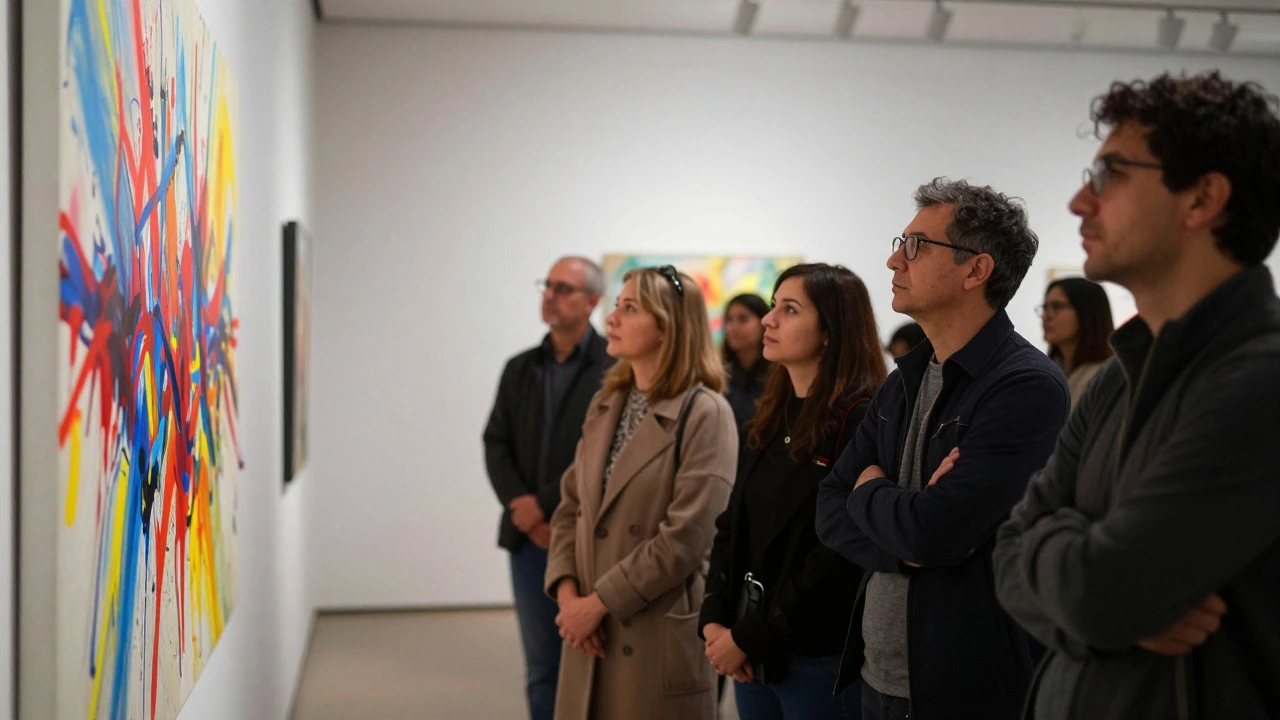
Abstract Art Style Decoder
Characterized by vertical and horizontal black lines creating a grid of rectangles filled with primary colors (red, blue, yellow) and white space.
Chaotic web of dripped and splattered paint layers. The canvas looks like a complex net of energetic lines covering the entire surface.
Large, soft-edged rectangular blocks of solid color floating against a dark or light background. Minimal detail, designed for immersion.
Fluid brushstrokes combined with circles, triangles, and jagged lines. Looks like a musical score translated into shapes and vibrant colors.
Have you ever stood in front of a canvas splashed with chaotic colors and shapes, felt completely lost, and wondered if you were missing the point? You are not alone. For decades, abstract art is a style of visual art that does not attempt to represent an accurate depiction of visual reality but instead uses shapes, colors, forms, and gestural marks to achieve its effect. It has been dismissed as something anyone could do, or worse, labeled as a scam for people who don't know how to draw.
But here is the truth: abstract art isn't about what you see on the surface. It is about what you feel inside. It is a direct conversation between the artist’s emotion and your own perception, bypassing the need for recognizable objects like trees, faces, or buildings. If you want to stop feeling confused and start actually seeing these works, you have to change how you look at them.
The Core Meaning: Breaking Free from Reality
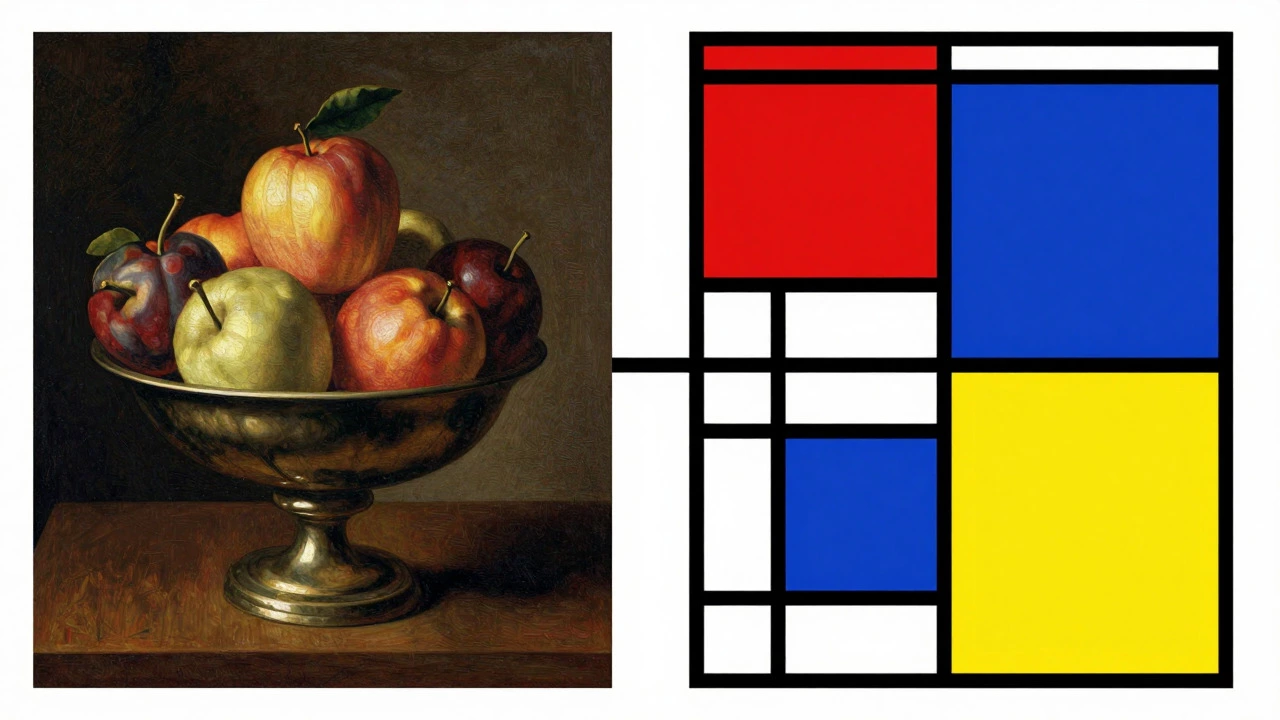
To understand the meaning of abstract art, you first have to unlearn the idea that art must copy life. For centuries, Western art was judged by how realistically it depicted the world. If you painted a bowl of fruit, critics looked at whether the shadows were correct and the reflections accurate. This is called representational art.
Abstract art breaks this rule entirely. It is non-representational. The subject matter is not the object itself, but the act of painting, the color, and the composition. Think of it like music. When you listen to a symphony, you aren't trying to identify a specific tree or a person's face in the sound. You feel joy, sadness, tension, or release. Abstract art tries to do the same thing visually. It translates emotions into visual language.
When you look at a piece of abstract art, ask yourself: What does this make me feel? Does the red feel aggressive or passionate? Do the jagged lines create anxiety or energy? There is no wrong answer. The "meaning" is often created by you, the viewer, in that moment of interaction.
How Did We Get Here? A Brief History
Abstract art didn't appear out of nowhere. It was a radical shift that happened mostly in the early 20th century, driven by artists who wanted to express the inner spiritual world rather than the outer physical one.
- Wassily Kandinsky (1866-1944): Often credited as the pioneer of pure abstraction. He believed colors and shapes had spiritual resonance. His 1911 work, Composition VII, is a whirlwind of forms that he described as a "symphony" of colors.
- Kazimir Malevich (1879-1935): Founded Suprematism, focusing on basic geometric forms like squares and circles. His famous Black Square (1915) was meant to represent the "zero point" of painting-freedom from the burden of depicting objects.
- Piet Mondrian (1872-1944): Developed De Stijl, using only horizontal and vertical black lines with primary colors (red, blue, yellow) and white space. He sought universal harmony and balance through extreme simplification.
- Jackson Pollock (1912-1956): A key figure in Abstract Expressionism. He didn't use brushes in the traditional sense; he dripped and splattered paint onto canvases laid on the floor. This method, called "action painting," emphasized the physical act of creation.
These artists weren't trying to be difficult. They were responding to a changing world. The Industrial Revolution, World War I, and new scientific discoveries shattered old certainties. Art needed to reflect this new, fragmented, and emotional reality.
Major Styles Within Abstract Art
"Abstract art" is a broad umbrella term. Underneath it, there are distinct movements with very different goals and techniques. Knowing these styles helps you decode what an artist might be trying to say.
| Movement | Key Characteristics | Famous Artists | Goal/Vibe |
|---|---|---|---|
| Geometric Abstraction | Clean lines, sharp angles, mathematical precision, primary colors | Piet Mondrian, Kazimir Malevich | Order, harmony, universal structure |
| Lyrical Abstraction | Fluid brushstrokes, soft edges, emphasis on color and mood | Hilma af Klint, Wassily Kandinsky | Spirituality, emotion, personal expression |
| Abstract Expressionism | Large scale, energetic gestures, dripping paint, spontaneity | Jackson Pollock, Willem de Kooning | Raw emotion, subconscious action, chaos |
| Color Field Painting | Large areas of solid color, minimal detail, flat surfaces | Mark Rothko, Barnett Newman | Meditation, immersion, overwhelming presence |
If you see a grid of black lines and bright rectangles, you are likely looking at Geometric Abstraction. If you see huge blocks of floating color that seem to glow, that is Color Field Painting. Recognizing these patterns gives you a vocabulary to discuss the art.
How to Actually Appreciate Abstract Art
So, you are standing in a gallery or scrolling through an online collection. How do you engage with a painting that doesn't show anything familiar? Here is a practical approach:
- Step Back: Don't zoom in immediately. Step back until you can see the whole composition. Notice the overall balance. Is it heavy on one side? Is it chaotic or calm?
- Follow Your Eye: Let your eyes wander across the canvas. Where do they get stuck? Usually, high contrast areas or bright colors pull your attention. Trace the path your eye takes. That movement is part of the experience.
- Consider the Texture: Look closely at how the paint is applied. Is it thick and rough (impasto)? Is it smooth and glossy? The texture tells you about the artist's hand and energy. Jackson Pollock’s paintings, for example, have a complex web of layers that reveal the speed and direction of his movements.
- Ignore the Story: Stop asking, "What is it supposed to be?" Start asking, "How does it make me feel?" If it makes you uneasy, that might be exactly what the artist intended. If it calms you down, great. Your reaction is valid.
- Read the Context: Sometimes, knowing the title or the date helps. Mark Rothko’s dark, somber color fields from the late 1950s were influenced by his grief and the shadow of nuclear war. Knowing this adds depth, but it doesn't replace your own feeling.
Appreciation is a skill, like learning to taste wine or hear jazz. At first, everything might just look like noise. But with time, you start to notice nuances in color mixing, rhythm in brushstrokes, and tension in composition.

Common Misconceptions Debunked
There are many myths surrounding abstract art that prevent people from enjoying it. Let’s clear them up.
Myth 1: "My kid could do that." This is the most common complaint. While a child might splash paint on a wall, they rarely do it with intention, control, and compositional awareness. Abstract artists spend years mastering color theory, balance, and technique before they "break the rules." A child’s scribble is random; an abstract painter’s mark is deliberate. Every drop of paint in a Pollock painting is placed with purpose, even if it looks accidental.
Myth 2: "It’s just random." Randomness lacks intent. Abstract art is highly structured, even when it looks chaotic. Artists carefully plan the placement of colors and shapes to create visual tension or harmony. It is like improvisational jazz-it sounds free, but it relies on deep knowledge of music theory and practice.
Myth 3: "You have to be educated to understand it." Not true. You don’t need an art degree to feel the impact of a Rothko painting. Education helps you analyze the historical context, but the emotional response is universal. If a painting moves you, you already understand it.
Why Abstract Art Matters Today
In a world saturated with literal images-photos, videos, advertisements-abstract art offers a rare break from representation. It forces us to slow down and think differently. It challenges our brain to process information without relying on familiar labels.
Moreover, abstract art continues to evolve. Contemporary artists use digital tools, AI, and new materials to push boundaries further. The core principle remains the same: exploring the limits of visual expression beyond the visible world. Whether you hang a small geometric print in your home or visit a large-scale installation, abstract art invites you to participate in creating its meaning.
Next time you encounter a confusing splash of color, don’t walk away. Stand still. Breathe. Ask yourself what it feels like. That is where the real art begins.
Is abstract art considered modern or contemporary?
Abstract art originated in the Modern Art period (early 20th century) with artists like Kandinsky and Mondrian. However, it is also a major part of Contemporary Art today. Many living artists continue to work in abstract styles, so it spans both categories depending on when the work was created.
Who invented abstract art?
There is no single inventor, but Wassily Kandinsky is widely credited with creating the first purely abstract paintings around 1910-1911. Hilma af Klint, a Swedish artist, created abstract works earlier, in the 1900s, but her work was not publicly exhibited until much later. Kazimir Malevich also independently developed abstraction in Russia around the same time.
Can abstract art have a hidden message?
Yes, sometimes. Some abstract artists embed symbols, political statements, or personal narratives into their work. However, many abstract artists believe the meaning is purely emotional or formal (about color and shape). It depends on the artist. Reading the artist's statement can help clarify if there is a specific hidden message.
Why is abstract art so expensive?
The price of art is determined by market factors, not just effort. Factors include the artist's reputation, historical significance, rarity, provenance (history of ownership), and demand from collectors. Famous abstract artists like Jackson Pollock or Mark Rothko set records because their work defined entire movements and is scarce.
What is the difference between abstract and non-representational art?
These terms are often used interchangeably, but there is a subtle difference. Non-representational art has no reference to the real world at all (pure shapes/colors). Abstract art can distort or simplify real-world objects but still hint at them. For example, a Picasso portrait is abstract but still represents a person. A Mondrian grid is non-representational.
