Modern Art Decoder
This interactive demonstrates how modern art shifts focus from realistic replication to emotional expression and conceptual ideas. Use the tools below to manipulate a digital canvas and observe how changes in technique alter the viewer's interpretation.
Analysis Result
Key Visual Indicators:
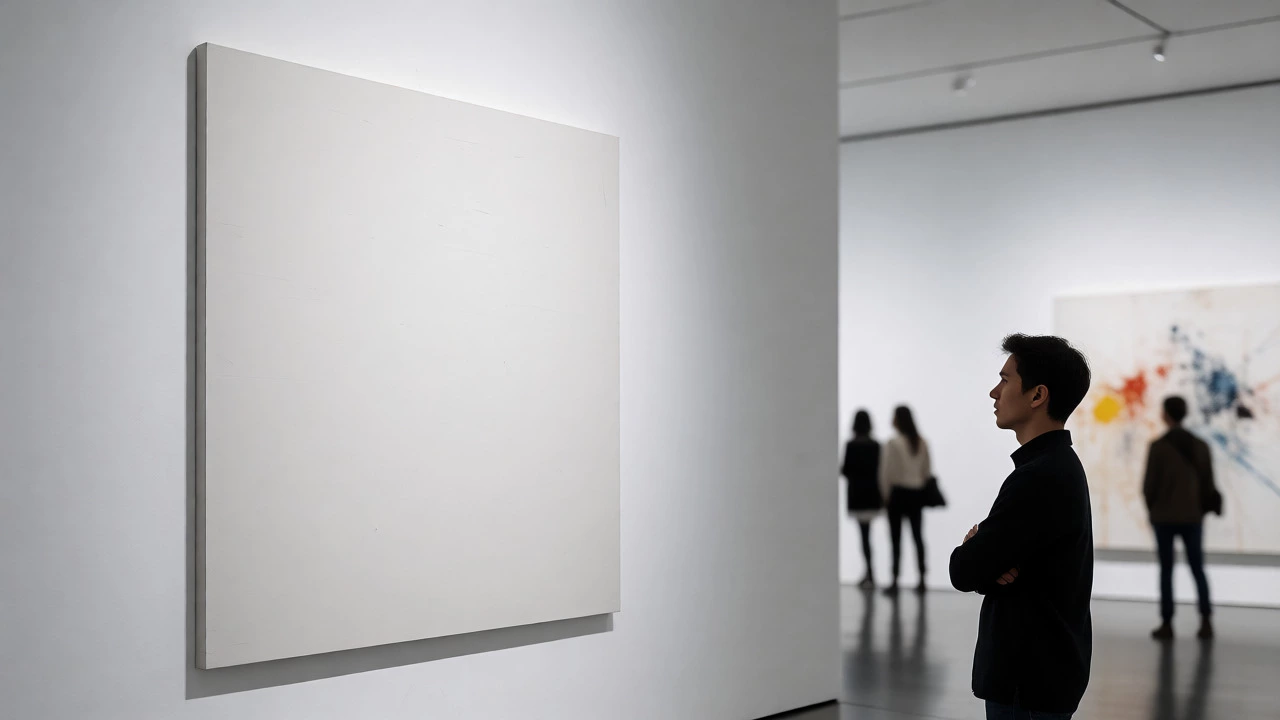
You stand in front of a canvas that looks like someone sneezed paint onto it. Or maybe it’s just a white square. Or a urinal signed "R. Mutt." Your first instinct isn't awe; it's confusion. You think, "My kid could do that," or worse, "Is this even art?" This reaction is normal. In fact, it’s exactly what the artists wanted.
Modern Art is not about showing you what something looks like. It is about showing you how the artist felt, thought, or perceived reality during a specific historical moment. Unlike the centuries of art before it, which aimed to mirror the physical world with photographic precision, modern art-roughly spanning from the 1860s to the 1970s-shattered the mirror. It stopped asking "What does this look like?" and started asking "What does this mean?" or "How does this make you feel?"
The Shift from Replication to Expression
To understand what modern art shows, you have to look at what came before. For hundreds of years, if you commissioned a portrait, you expected it to look like you. If you painted a landscape, you expected trees to be green and skies blue. The job of the artist was technical mastery: capturing light, shadow, and form accurately.
Then photography happened. Once a camera could capture a perfect likeness instantly, painting didn’t need to compete on realism anymore. Artists were freed. They realized they could use color, shape, and line to express things cameras couldn't catch: emotion, movement, time, and subconscious thoughts.
This shift wasn't gradual for everyone; it was explosive. When Impressionism emerged in the late 19th century, critics hated it. They called Monet’s paintings "unfinished sketches." But Monet wasn't trying to paint a cathedral; he was painting the light hitting the cathedral at 7:00 AM versus 5:00 PM. He showed the fleeting nature of time.
Emotion Over Accuracy: The Role of Color and Form
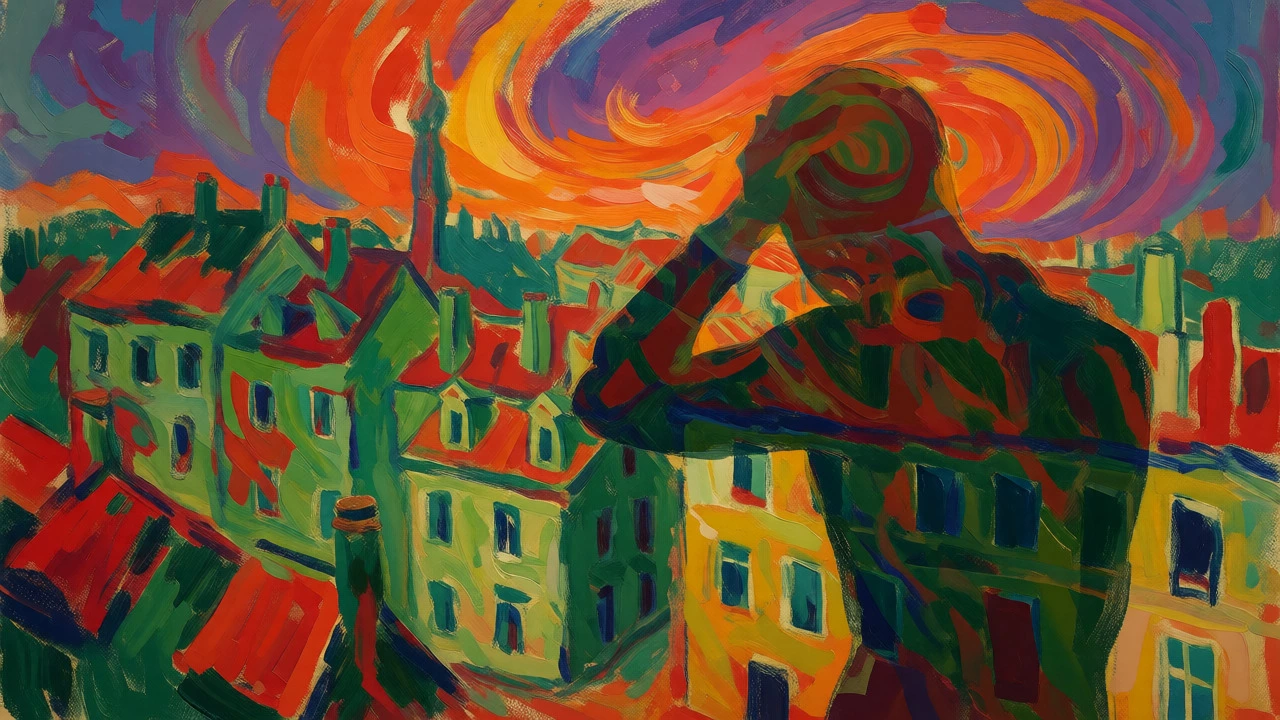
If Impressionism broke the rules of light, movements like Fauvism broke the rules of color. Henri Matisse painted faces with green noses and red hair. Why? Because those colors felt right emotionally, not visually. A green nose doesn't exist in biology, but it exists in anxiety or excitement.
Later, Expressionism took this further. Edvard Munch’s The Scream isn't a realistic depiction of a person yelling. It’s a visualization of internal panic. The sky swirls because his mind was swirling. The figure is distorted because fear distorts our self-perception. When you look at modern art, you aren't looking at an object; you are looking at a psychological state made visible.
Think about your own emotions. When you’re angry, do you see the world in soft pastels? No. You might see sharp edges, loud noises, chaotic patterns. Modern artists tried to translate that sensory experience into paint. So, when you see jagged lines and clashing colors, the artwork is showing you conflict, tension, or energy.
Deconstructing Reality: Cubism and Perspective
One of the biggest questions people ask is, "Why are the faces broken?" Enter Cubism, pioneered by Pablo Picasso and Georges Braque. Before Cubism, painters used linear perspective-a trick invented in the Renaissance-to create the illusion of depth on a flat surface. You looked through a 'window' into a scene.
Picasso said, "No. We don't see the world through a window. We move around objects. We see them from multiple angles simultaneously." If you walk around a friend, you see their profile, then their back, then their face. Cubism tries to show all those views at once. It flattens space. It shows the concept of an object rather than a single frozen snapshot.
This is crucial: Modern art often shows time. Traditional art freezes a second. Modern art often tries to compress hours, days, or different viewpoints into one image. It acknowledges that human perception is active, not passive.
| Feature | Traditional Art (Pre-1860s) | Modern Art (1860s-1970s) |
|---|---|---|
| Primary Goal | Mimetic representation (mirroring reality) | Expressive or conceptual exploration |
| Use of Color | Naturalistic (matching real life) | Symbolic or Emotional (arbitrary choices) |
| Perspective | Fixed, single-point linear perspective | Multiple viewpoints, flattened space, or abstraction |
| Subject Matter | Religion, mythology, royalty, landscapes | Everyday life, psychology, formal elements, politics |
| Viewer's Role | Passive observer of a scene | Active interpreter of meaning or feeling |
The Rise of Abstraction: Showing Pure Feeling
Eventually, some artists decided that recognizable objects were still too much clutter. What if you removed the subject entirely? This led to Abstract Art. Wassily Kandinsky believed that colors and shapes had inherent spiritual vibrations, similar to music. A yellow triangle might feel aggressive; a blue circle might feel calm.
In the mid-20th century, Abstract Expressionism dominated New York. Jackson Pollock didn't paint pictures of things; he painted the act of painting itself. His drip paintings show energy, rhythm, and chaos. They are records of movement. When you look at a Pollock, you are seeing the physical trace of his body moving across the canvas. It shows process, not product.
This can be hard to grasp. We are trained to look for hidden symbols. But sometimes, there is no hidden symbol. The artwork shows the pure aesthetic experience of balance, contrast, and harmony. It asks you to stop thinking logically and start feeling intuitively.
Conceptual Art: Ideas as Objects
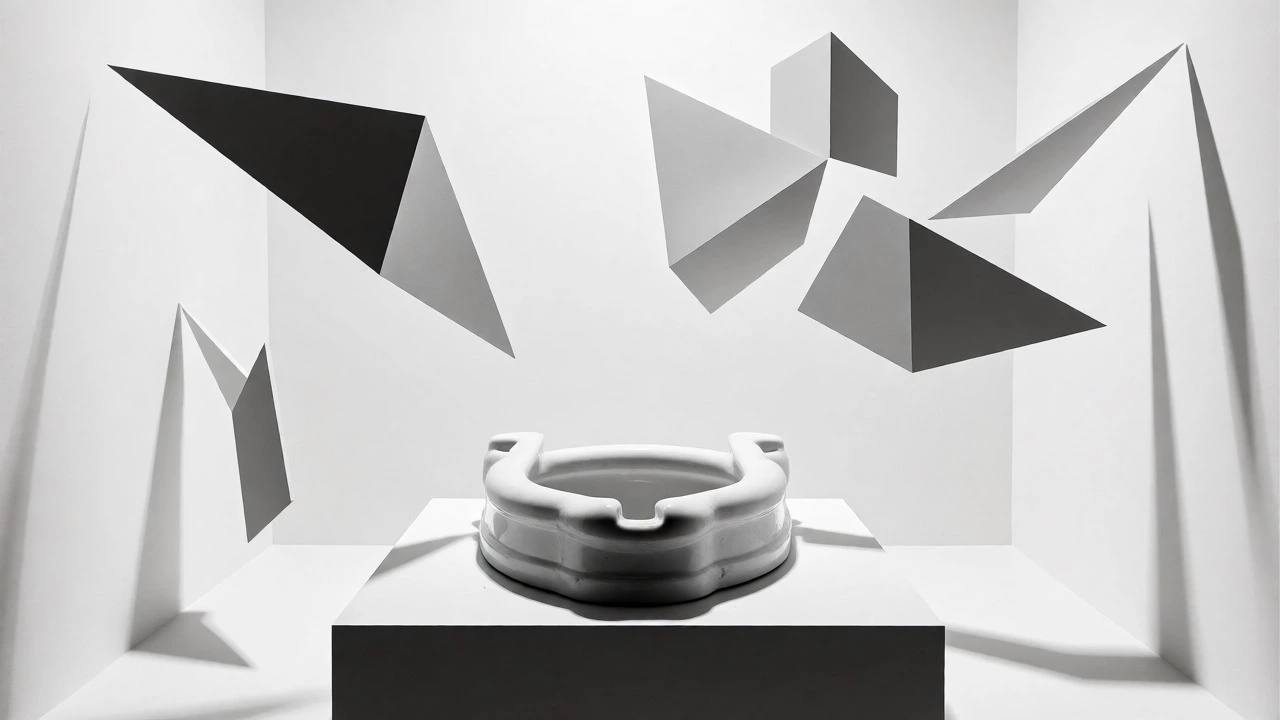
By the 1960s, the question shifted again. If we’ve moved beyond realism and beyond pure emotion, what’s left? The idea. Conceptual Art argues that the concept behind the work is more important than the finished art object. Marcel Duchamp’s Fountain (a urinal) is the classic example.
Duchamp wasn't saying the urinal was beautiful. He was asking: "Who decides what art is?" By placing a factory-made object in a gallery, he showed that context defines value. Modern art increasingly became about questioning the institution of art itself. It shows social commentary, political critique, and philosophical puzzles.
When you see a pile of bricks labeled "Art" (like Carl Andre’s Equivalent VIII), it’s not trying to trick you. It’s forcing you to confront your own biases. Why do we accept a diamond as valuable but reject a brick? Modern art exposes these arbitrary cultural rules.
How to Actually Look at Modern Art
So, next time you’re in a museum and feel lost, try this checklist instead of looking for a pretty picture:
- Ask "What is the artist reacting to?" Most modern art is a response to something-war, industrialization, technology, or previous art styles. Picasso reacted to African masks and Cézanne. Warhol reacted to consumer culture.
- Focus on the Formal Elements. Ignore the subject for a minute. Look at the composition. Is it balanced or chaotic? Are the colors warm or cold? Do the lines lead your eye or block it? These choices convey mood.
- Consider the Title. Sometimes the title is the key. A painting of random blobs might be called "Grief" or "Celebration." The title guides your emotional interpretation.
- Accept Ambiguity. There is rarely one "right" answer. If two people see different meanings, both are valid. The art shows a spectrum of possibilities, not a single fact.
Modern art doesn't show you the world as it is. It shows you the world as humans experience it-fragmented, emotional, subjective, and constantly changing. It holds up a funhouse mirror, not a bathroom mirror. And while the reflection might be distorted, it’s often closer to the truth of our inner lives than a photograph ever could be.
Why does modern art look so simple or childish?
It often looks simple because the artists deliberately stripped away complex techniques to focus on raw expression or fundamental forms. Movements like Primitiveism admired the directness of children's art or non-Western traditions, believing academic training had stifled genuine creativity. The simplicity is a stylistic choice to prioritize impact over technical mimicry.
Is modern art just money laundering for the rich?
While high prices can be driven by speculation and status, the art itself has historical and cultural significance. Collectors buy it because it represents pivotal moments in human thought and visual language. Like rare books or historical artifacts, its value comes from its role in defining a cultural era, not just its material cost.
What is the difference between modern and contemporary art?
Modern art generally refers to the period from the 1860s to the 1970s, characterized by a break from tradition and experimentation with new materials and ideas. Contemporary art refers to art produced from the 1970s to today. Contemporary art is often more globalized, digital, and focused on identity, politics, and media, whereas modern art was heavily focused on formal innovation and individual expression.
Do I need to know art history to enjoy modern art?
No, you don't need a degree. However, knowing basic context helps. Understanding that a painting was created during World War I or during the rise of advertising adds layers of meaning. But ultimately, art is meant to evoke a personal response. If it makes you feel something-even curiosity or anger-it is working.
Why are some modern artworks just text or instructions?
This stems from Conceptual Art, where the idea is the artwork. Sol LeWitt, for example, wrote instructions for wall drawings that others executed. This shifts the focus from the artist's hand to the artist's mind. It challenges the notion that art must be handmade or visually pleasing, emphasizing intellectual engagement instead.