Contemporary Art Decoder
The Urinal
A porcelain urinal signed "R. Mutt" sits on a pedestal in a gallery space.
Taped Banana
A ripe banana is duct-taped to a white wall at a major art exhibition.
White Canvas
A pristine white canvas hangs alone, seemingly empty of any marks or images.
Pile of Bricks
Construction bricks are stacked in a neat pile inside a museum gallery.
Polka Dots
An entire room is covered in repetitive red polka dots on white walls and floor.
Community Meal
Strangers share a free dinner organized by an artist in a public park.
The Hidden Meaning
Key Concepts
Questions to Ask Yourself
Have you ever walked into a gallery, stared at a blank canvas or a single red line on a wall, and thought, I could do that? You are not alone. This reaction is the most common entry point into the world of contemporary art, which often looks deceptively simple to the untrained eye. But that simplicity is rarely an accident. It is usually a deliberate strategy designed to shift your focus from technical skill to idea, context, and emotion.
When we ask why contemporary art is so simple, we are often measuring it against the wrong ruler. We judge a conceptual piece by the standards of Renaissance realism, looking for brushwork and perspective when the artist is actually asking us to look at power structures, identity, or the nature of art itself. The "simplicity" you see is often the surface of a complex intellectual or emotional argument.
The Shift from Skill to Idea
To understand the visual reduction in modern galleries, we have to look back at the late 19th century. Before this era, art was largely defined by craftsmanship. If you wanted to be taken seriously, you needed to master anatomy, lighting, and composition. But then came photography. Suddenly, a machine could capture reality faster and more accurately than any painter. This forced artists to ask: if the camera can record the world, what is left for me to do?
This question led to movements like Impressionism and later Cubism, which broke away from realistic representation. By the mid-20th century, this evolution culminated in Conceptual Art. In this movement, the idea behind the work became more important than the physical object. The execution could be simple because the complexity lay in the concept. A text description of an artwork could be the artwork itself.
Think of it like software coding. The user interface might be clean and simple, with just one button. But underneath, thousands of lines of code are running to make that button work. In conceptual art, the "code" is the research, the philosophy, and the cultural commentary. The simple image is just the interface.
The Legacy of Marcel Duchamp and the Readymade
You cannot talk about simple art without mentioning Marcel Duchamp. In 1917, he submitted a urinal to an art exhibition, signed it "R. Mutt," and titled it Fountain. He didn't carve it; he bought it. Was this lazy? Or was it a radical statement that challenged the definition of art?
Duchamp introduced the concept of the readymade. By taking an ordinary object and placing it in a gallery context, he forced viewers to question why we value certain objects as art and others as trash. This paved the way for later artists who used everyday materials. When you see a pile of bricks or a chair in a museum today, it is standing on the shoulders of Duchamp’s challenge to institutional authority.
| Era | Primary Focus | Key Question |
|---|---|---|
| Classical/Renaissance | Technical Mastery & Realism | How well can I replicate reality? |
| Modernist (Early 20th C) | Form, Color & Emotion | How can I express inner truth? |
| Contemporary (Late 20th C-Present) | Idea, Context & Concept | What does this mean in society? |
Minimalism: Less is More
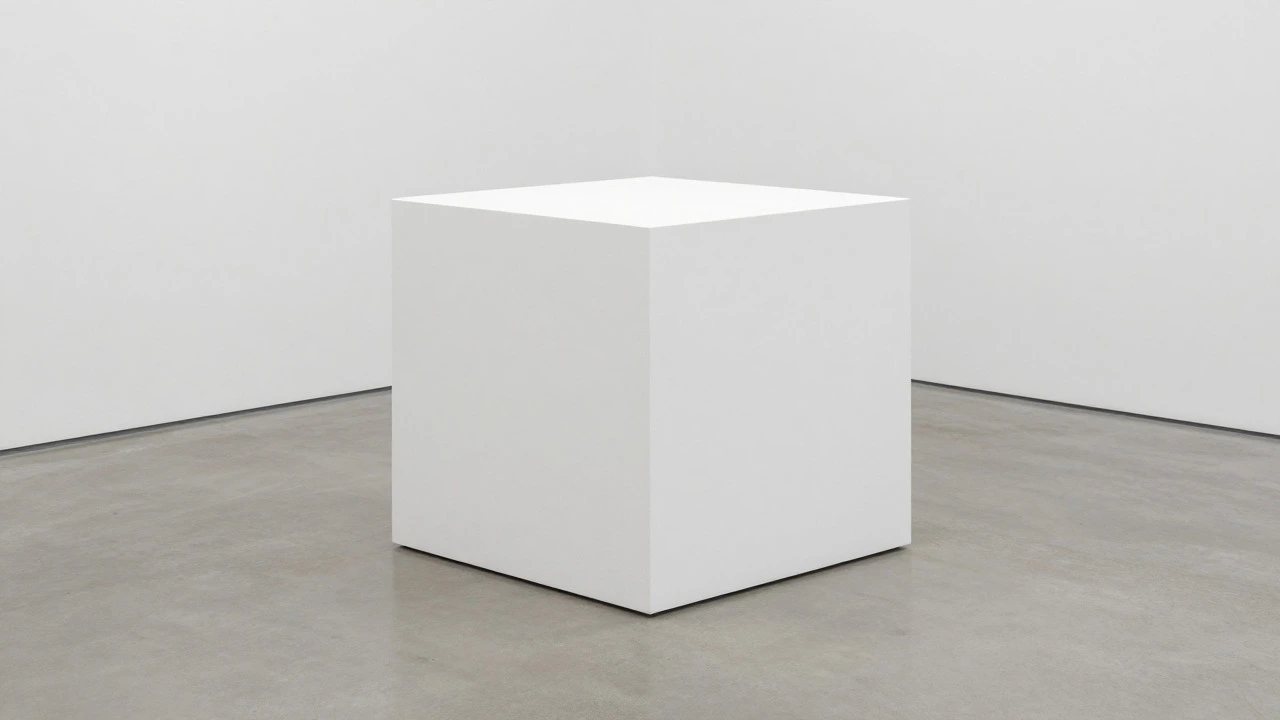
Another major reason contemporary art looks simple is the influence of Minimalism. Emerging in the 1960s, Minimalist artists rejected the emotional excesses of Abstract Expressionism. They wanted art to be objective, industrial, and stripped of personal gesture. Artists like Donald Judd created geometric shapes out of steel, plywood, and Plexiglas. These works looked like furniture or architecture, not traditional paintings.
The simplicity here serves a specific purpose: presence. By removing decorative details, the object forces you to confront its physicality-its weight, its texture, its relationship to the space around it. A large white cube isn't "empty"; it is demanding that you notice the air inside the room, the light hitting the floor, and your own body moving around it. It turns viewing into an experience rather than a passive observation.
Context is King
In contemporary art, where something is displayed changes what it means. A banana taped to a wall in your kitchen is fruit. That same banana, taped to a wall in a prestigious Venice Biennale booth, becomes a commentary on waste, value, and the absurdity of the art market. This is the case with Maurizio Cattelan’s Comedian (2019).
Critics called it a joke, but the artwork’s power came from the public’s reaction. People took photos of it, discussed it online, and debated its worth. The art wasn't just the banana; it was the entire social media storm that erupted around it. The simplicity of the object made it accessible, allowing millions to engage with a critique of luxury and commodification. Without the simple visual hook, the complex message wouldn't have spread.
Democratizing Art Making
There is also a democratic impulse behind the simplicity. Traditional art required years of expensive training and access to studios. Contemporary practices often use found objects, digital tools, or performance, which lowers the barrier to entry. This allows voices from marginalized communities, who may not have had access to classical academies, to tell their stories using materials available to them.
For example, social practice art involves community engagement rather than creating a static object. An artist might organize a free meal or a neighborhood cleanup. To an outsider, this doesn't look like "art." But within the framework of contemporary culture, these actions are framed as artistic interventions that highlight social issues. The simplicity of the action makes it relatable and participatory.
How to Look at Simple Art
If you want to get more out of contemporary art, try shifting your approach. Instead of asking "Can I draw this?" ask yourself:
- What is the context? Where is this displayed? Who commissioned it? What is happening in the world right now?
- What is missing? Why did the artist choose to remove detail? What does that absence make you feel?
- What is the material saying? Is the use of cheap plastic intentional? Does the fragility of the object mirror a fragile political situation?
- How does it make me feel? Are you bored? Angry? Confused? Your emotional reaction is part of the data the artist is collecting.
Art historian Jerry Saltz famously said, "You don't have to like it, but you have to respect the conversation." The simplicity is an invitation to join that conversation, not a test of your drawing skills.
The Role of Technology and Reproduction
In the age of Instagram, art has become increasingly visual and immediate. Complex, detailed paintings can get lost in a scroll. Simple, bold images stop the thumb. While this isn't the only reason for minimalism, the need for visual impact in a digital landscape has reinforced trends toward clarity and starkness. Artists like Yayoi Kusama with her polka dots create immersive, photogenic environments that thrive on both physical presence and digital sharing.
Furthermore, digital art and NFTs have blurred the lines between ownership and display. A pixelated ape or a simple animated loop can sell for millions because the value is tied to community, scarcity, and brand identity, not just aesthetic complexity. This mirrors the broader economic shifts in how we assign value in the 21st century.
Is It Really Simple?
So, is contemporary art simple? Visually, yes. Intellectually, emotionally, and culturally, no. The apparent ease of creation masks layers of historical reference, philosophical inquiry, and social critique. When you next encounter a piece that seems too easy, pause. Don't dismiss it. Ask what it is trying to say, not just how it was made. You might find that the simplest pieces hold the heaviest ideas.
Why do people hate contemporary art?
Many people dislike contemporary art because they expect it to demonstrate technical skill or beauty. When art prioritizes concept over craftsmanship, it can feel exclusionary or pretentious to viewers who aren't familiar with the theoretical background. Additionally, the high prices associated with some contemporary works fuel resentment, making the art seem like a scam rather than a genuine expression.
Who decided that simple things are art?
No single person decided this. It was a gradual shift driven by artists, curators, critics, and historians over the last century. Key figures like Marcel Duchamp challenged definitions, while institutions like museums and galleries validated new forms by displaying them. The consensus is that art is defined by intent and context, not just by the difficulty of its production.
Is all contemporary art minimalist?
No. Contemporary art is incredibly diverse. While minimalism and conceptual art are prominent, many contemporary artists create highly detailed, figurative, and technically complex works. Artists like Kehinde Wiley or Kerry James Marshall use traditional painting techniques to explore modern themes of race and identity. The "simple" art is just one visible strand of a much larger tapestry.
Why is contemporary art so expensive?
The price of art is determined by the market, not the cost of materials. Factors include the artist's reputation, provenance (history of ownership), rarity, and demand from collectors. Often, art functions as an investment asset or a status symbol. The simplicity of the work doesn't lower its value if the artist's brand is strong and the concept is culturally significant.
How can I appreciate art I don't understand?
Start by accepting that you don't need to "get it" immediately. Look at the work for five minutes. Notice your physical reactions. Read the placard for context. Then, decide if the idea resonates with you. Appreciation doesn't mean liking; it means engaging with the artist's intent. Over time, exposure will help you recognize recurring themes and strategies across different works.