♫ Musical Dynamics Explorer
Click on any dynamic marking below to see its meaning and estimated volume level. This tool helps you understand the range from a whisper (pianississimo) to a shout (fortississimo).
Dynamic Markings
Volume Visualization
Click a button on the left to explore how different dynamic markings affect the perceived volume of a musical piece.
Ever tried to tell a musician to play louder by just saying "make it big"? It usually doesn't work. In the world of musical dynamics is the variation in loudness between notes or parts of a musical composition, there are specific words that act as precise instructions for volume. If you are looking for the single word that means "loud" in standard sheet music, the answer is forte. But the reality is a bit more nuanced, involving a scale of Italian terms that range from whisper-quiet to ear-splitting.
Understanding these terms isn't just about passing a theory exam; it's about controlling how your music feels to the listener. Whether you are a composer writing a symphony, a producer mixing a pop track, or a student learning piano, knowing the difference between a soft piano and a crashing fortissimo changes everything. Let's break down exactly which words signal volume and how they fit into the broader language of sound.
The Core Vocabulary: Forte and Piano
At the heart of musical volume lies a pair of Italian words that have become universal across all genres of Western classical and contemporary music. The most direct answer to "what word is loud?" is Forte (abbreviated as f). This term literally translates to "strong" or "loud." When you see an f on a staff, the instruction is clear: play with energy and projection.
On the opposite end of the spectrum sits Piano (abbreviated as p). Confusingly, this word sounds like the instrument itself, but in musical notation, it simply means "soft." So, if you are reading a score and see a p, hold back. Keep the tone intimate and controlled.
These two letters form the baseline of dynamic expression. However, composers rarely stop at just "loud" or "soft." They want shades of gray, sudden spikes, and gradual builds. That’s where the extended vocabulary comes in.
Beyond Basic: The Dynamic Scale
Musical dynamics operate on a continuum rather than a binary switch. To give performers more control, several intermediate and extreme terms exist. Here is how the main dynamic markings stack up, from quietest to loudest:
| Term | Abbreviation | Meaning | Relative Volume Level |
|---|---|---|---|
| ppp | ppp | Pianississimo | Very, very soft |
| pp | pp | Pianissimo | Very soft |
| p | p | Piano | Soft |
| mp | mp | Mezzo-piano | Medium-soft |
| mf | mf | Mezzo-forte | Medium-loud |
| f | f | Forte | Loud |
| ff | ff | Fortissimo | Very loud |
| fff | fff | Fortississimo | Extremely loud |
Notice the pattern: adding more letters intensifies the effect. Mezzo is Italian for "half," so mezzo-forte is half-loud, and mezzo-piano is half-soft. These middle-ground terms are crucial because they allow for subtle emotional shifts without jarring the listener. A piece might start at mp to create tension, swell to mf for development, and explode into ff for the climax.
How Dynamics Change Over Time
Volume isn't static. A note can be loud, but what happens to the next note matters just as much. This is where dynamic shapes come in. Two primary symbols describe how volume changes over time:
- Crescendo (cresc.): This means to gradually get louder. Imagine a wave building up before it crashes. You often see a hairpin opening to the right (
 ) indicating this increase.
 - Decrescendo (decresc.) or Diminuendo (dim.): This means to gradually get softer. The hairpin closes to the left, signaling a fade-out or a retreat into intimacy.
There are also abrupt changes. Sforzando (marked sfz) tells a player to hit a single note or chord with sudden, unexpected force. It’s like a shout in a quiet conversation. Conversely, sotto voce suggests playing "under the voice," implying a hushed, secretive quality even if the dynamic marking is technically p.

Dynamics in Modern Music Production
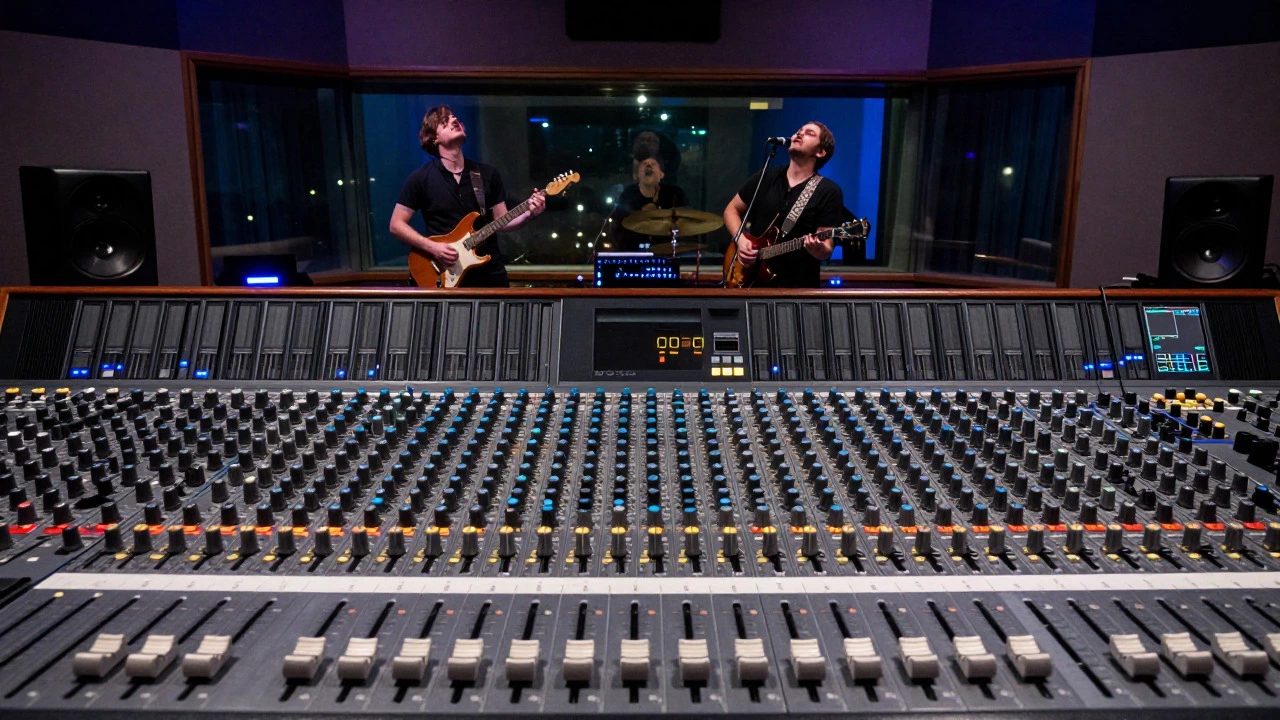
You might wonder if these old Italian terms still matter when we're working with digital audio workstations and synthesizers. Absolutely. While electronic producers often use decibels (dB) and gain staging, the conceptual framework remains the same. In mixing, we talk about "riding the faders" to create crescendos or using compression to keep the forte sections from clipping while keeping the piano sections audible.
In rock and metal, for example, dynamic contrast is a key tool for impact. Think of bands like Tool or Radiohead. They rely heavily on shifting from pp atmospheric intros to ff heavy riffs. Without understanding the concept of forte versus piano, a producer might mix a track that feels flat-everything at the same volume level, resulting in no emotional peak or valley.
Even in hip-hop, where beats are often consistent, vocalists use dynamic phrasing. A rapper might whisper a verse (p) and then project the hook (f). This contrast grabs attention. So, whether you are conducting an orchestra or adjusting a channel strip in Pro Tools, the principle holds: variation in volume creates interest.
Common Misconceptions and Pitfalls
One common mistake beginners make is assuming that forte always means the maximum possible volume. In reality, context is king. A forte in a chamber quartet sounds different from a forte in a full orchestra. The relative volume depends on the ensemble size and the acoustic space. Similarly, piano doesn't mean silent; it means softer than the surrounding material.
Another pitfall is ignoring the tempo relationship. Fast passages naturally sound louder due to increased air movement or string friction, even if the dynamic marking stays the same. Slower passages may require more effort to maintain a forte level because each note sustains longer. Experienced musicians adjust their technique to compensate for these physical realities.
Practical Tips for Using Dynamic Terms
If you are writing music or analyzing scores, keep these practical guidelines in mind:
- Start with Contrast: Don't write everything at mf. Use the full range from pp to ff to create dramatic arcs.
- Be Specific: If you want a sudden shock, use sfz. If you want a slow build, use a crescendo line. Vague instructions lead to inconsistent performances.
- Consider the Instrument: A flute has a limited dynamic range compared to a trumpet. Knowing the capabilities of each instrument helps you write realistic dynamic markings.
- Listen to References: Study recordings of great conductors like Leonard Bernstein or Itzhak Perlman. Notice how they interpret forte not just as loud, but as intense and forward-moving.
By mastering these terms, you move beyond simply playing notes correctly. You start shaping the emotional journey of the piece. The word forte is your anchor for loudness, but the entire family of dynamic markings gives you the brushstrokes to paint that volume landscape.
Frequently Asked Questions
What is the loudest dynamic marking in music?
The standard loudest marking is fortississimo (fff). However, composers sometimes go further with ffff or even higher, though these are rare and depend on the instrument's capability to produce such intensity.
Does forte mean the same thing in all instruments?
Not exactly. While forte always means "loud," the actual decibel level varies by instrument. A trumpet at forte will be significantly louder than a violin at forte. Musicians calibrate their volume relative to the ensemble balance.
Why do musicians use Italian terms for dynamics?
Most foundational Western classical music was composed in Italy during the Renaissance and Baroque periods. As these conventions spread across Europe, the Italian terminology became the international standard for musical notation, persisting to this day regardless of the composer's native language.
What is the difference between mezzo-forte and forte?
Mezzo-forte (mf) is moderately loud, sitting between medium and strong. Forte (f) is fully loud. The difference is subjective but generally represents a noticeable step up in intensity and projection.
Can dynamics be written in English?
Yes, especially in modern popular music, jazz charts, or informal settings. You might see "play loud" or "softly" written directly. However, in formal classical notation, the Italian abbreviations (f, p, mf, etc.) remain the global standard for clarity and brevity.
