Most Played Song Explorer
Discover which songs dominate different music consumption categories. Select a category below to see the champion tracks and their impressive statistics.
The Problem with Asking "Who Has the Most Plays?"
You might expect a single name to pop up when you ask what is the most played song. You probably imagine a catchy pop hit or a classic rock anthem that everyone knows. But here’s the catch: there is no single answer. That’s because we don’t have one universal counter for every song ever created.
We live in an era of fragmented data. Streaming services like Spotify and Apple Music keep their numbers private or update them differently. Radio stations across the globe don’t share a central database. And radio play from the 1950s was recorded on paper logs, if at all. So, when people claim to know the "most played song," they are usually talking about a specific metric-like digital streams, radio spins, or total revenue-not a magical sum of every listen since time began.
To find the real winner, we need to look at three different categories: the streaming giants, the radio legends, and the best-selling tracks. Each category has its own champion, and understanding why helps us see how the music industry has changed over the last century.
The Streaming Era: Where Numbers Go Wild
If you define "played" as digital streams, the game changes completely. In the physical CD era, buying an album meant listening to it maybe ten times before moving on. Today, a song can be streamed millions of times in a single day. This shift favors short, catchy hooks and playlist-friendly vibes over complex compositions.
When we look at global streaming data, one track stands out above the rest. As of early 2026, Blinding Lights by The Weeknd holds the crown. It became the first song in history to reach 4 billion streams on Spotify alone. When you add YouTube, Apple Music, and other platforms, the number is significantly higher. Why did this song dominate? It tapped into a nostalgic 80s synth-pop sound that appealed to multiple generations simultaneously. It wasn't just a hit; it was a cultural reset.
Right behind it is Shape of You by Ed Sheeran. Released in 2017, it broke records for consecutive weeks at number one in multiple countries. Its success shows that mid-tempo pop songs with clear melodies still dominate the streaming landscape. Other contenders include Dance Monkey by Tones and I, which proved that organic, viral growth could rival major label pushes.
| Song Title | Artist | Release Year | Key Platform Record |
|---|---|---|---|
| Blinding Lights | The Weeknd | 2019 | First to 4B on Spotify |
| Shape of You | Ed Sheeran | 2017 | Most weeks at #1 globally |
| Dance Monkey | Tones and I | 2019 | Longest-charting solo female act |
| Someone You Loved | Lewis Capaldi | 2018 | Billboard Hot 100 longevity |
| One Dance | Drake | 2016 | First stream-only #1 hit |
The Radio Legends: Songs That Never Left the Airwaves
Streaming is new money. Radio is old money-and it’s stubborn. If you want to know what has been played the most in terms of sheer airtime hours, you have to look back further than 2019. Radio stations, especially in formats like Classic Rock and Adult Contemporary, rely on a small pool of proven hits to fill hours.
For decades, Bohemian Rhapsody by Queen has been cited as one of the most played songs in radio history. Its structure defies the typical verse-chorus format, yet it remains endlessly replayable. But there’s another contender that often gets overlooked: I Will Always Love You by Whitney Houston.
Why Whitney? Because her version, released in 1993, became the definitive ballad for weddings, funerals, and slow-dance moments worldwide. It doesn’t just get played on music channels; it gets played at events. While we can’t count every wedding DJ set, the cumulative radio spins over thirty years put it in a league of its own. Similarly, Stairway to Heaven by Led Zeppelin is a staple of rock radio. It’s long, it’s epic, and it’s always on.
Another heavy hitter is Happy Birthday. Technically, it’s not a "song" in the commercial sense-it’s a public domain tune-but if you count every birthday party, school assembly, and casual celebration, it is arguably the most performed piece of music in human history. However, since it generates no royalties and isn’t tracked by charts, it rarely makes these lists. We focus on commercial releases for fairness.
The Best-Selling Champion: Physical and Digital Sales
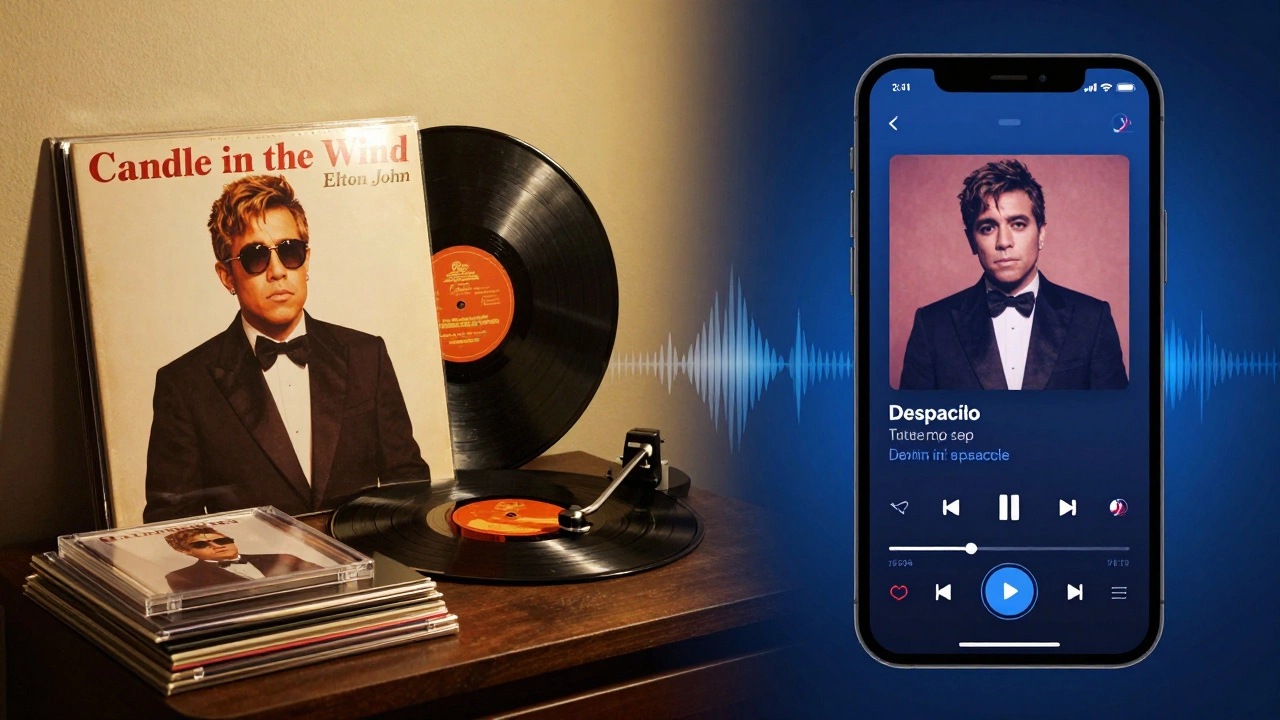
Sales tell a different story than streams or radio plays. A sale implies a purchase-a deliberate decision to own the music. For many years, Guinness World Records held Candle in the Wind 1997 by Elton John as the best-selling single of all time.
This wasn’t just a hit; it was a tribute to Princess Diana after her death. The emotional weight of the moment drove massive sales, estimated at over 45 million copies worldwide. It’s a unique case where cultural grief translated directly into purchasing power. No other song has replicated this phenomenon because modern consumption is less about owning singles and more about accessing libraries.
In the digital age, Rolling in the Deep by Adele and Baby by Justin Bieber hold strong positions in digital download sales. But Elton John’s record remains untouchable in terms of pure unit movement. It highlights a key difference: streaming measures attention, while sales measure commitment.
Why "Despacito" Changed the Game
We can’t talk about most-played songs without mentioning Despacito by Luis Fonsi featuring Daddy Yankee. In 2017, this track broke the record for most-watched video on YouTube, surpassing even Psy’s Gangnam Style.
YouTube views are a form of play, but they’re distinct from audio streams. People watch videos for the visual experience, the dance moves, or the cultural moment. Despacito’s success proved that language barriers didn’t matter anymore. It opened the door for non-English songs to compete for the title of most played. Today, Latin trap and reggaeton dominate global playlists, ensuring that future "most played" titles will likely come from artists outside the traditional Anglo-American market.
The Hidden Factor: Background Music and Sync Licensing
Here’s where things get tricky. How do you count a song played in a coffee shop, a supermarket, or a movie scene? These uses are licensed through performance rights organizations like ASCAP, BMI, or PRS for Music. They generate billions of plays annually, but they aren’t listed on any chart.
Songs like Smells Like Teen Spirit by Nirvana or Wonderwall by Oasis are constantly heard in background settings. They’ve become part of the ambient fabric of daily life. If we could track every instance of background play, the list would look very different. It would favor instrumental tracks, classical pieces like Clair de Lune by Debussy, and generic royalty-free music used in commercials.
However, since these aren’t attributed to a single artist in a searchable way, we exclude them from the main competition. We stick to songs identified by title and performer.
How Data Tracking Works (And Why It’s Flawed)
To understand why there’s no single answer, you need to understand the tracking mechanisms. In the US, Nielsen Media Research (now Luminate) tracks radio and TV airplay. They use specialized equipment to identify songs based on audio fingerprints. This data feeds the Billboard charts.
For streaming, companies report data to third-party aggregators like Chartmetric or Mediabase. But each platform calculates a "stream" differently. Does skipping a song after 30 seconds count? Does looping a track on repeat count as one play or many? Spotify counts a stream after 30 seconds. YouTube counts a view after a certain duration. These discrepancies make direct comparison nearly impossible.
Radios in developing nations often lack digital tracking systems. A song might be played thousands of times in rural India or Nigeria without ever being logged. This means our current "most played" lists are heavily biased toward Western markets and digital infrastructure.
Is Blinding Lights really the most played song ever?
It is the most played song in the streaming era. With over 4 billion streams on Spotify alone, it leads in digital consumption. However, it hasn’t had the decades-long radio rotation that older classics have enjoyed, so it may not be the most played overall if you include historical radio data.
Why isn't Happy Birthday on the list?
Happy Birthday is technically the most performed song in history due to its use at celebrations worldwide. However, it is in the public domain and doesn’t generate commercial royalties or chart data. Lists of "most played songs" typically focus on commercial recordings by specific artists.
Which song has sold the most copies?
Candle in the Wind 1997 by Elton John is recognized by Guinness World Records as the best-selling single of all time, with estimated sales of over 45 million copies. This includes both physical and digital sales.
Does radio play count more than streaming?
It depends on your definition of "play." Radio reaches a broad audience passively, while streaming requires active choice. Historically, radio dominated, but streaming now accounts for the majority of music consumption in developed markets. For longevity, radio still gives older songs more total plays over time.
Will AI-generated music change who has the most plays?
Potentially. As AI tools create personalized background music, generic tracks might accumulate billions of plays. However, mainstream culture tends to gravitate toward human-created art with emotional resonance. For now, human artists still dominate the top spots.