Ancient Landscape Explorer
Explore the journey of how humans began to paint nature for its own sake. Use the tabs below to view a chronological timeline or test your understanding of key concepts.
Chronological Overview
Quiz Complete!
You scored:
Imagine standing in a dimly lit museum, staring at a fragment of plaster. It’s cracked, faded, and barely recognizable as an image. Yet, hidden within those crumbling edges is a view of the world that hasn’t changed in four thousand years. This isn’t just about old paint; it’s about when humans first decided that the trees, rivers, and mountains were worth looking at for their own sake, not just as background scenery for gods or kings.
The question what is the oldest known landscape painting doesn’t have a single, simple answer because "landscape" means different things to different cultures across millennia. If you’re looking for the earliest depiction of nature as a standalone subject, we have to travel back to the Bronze Age. But if you mean the sophisticated tradition of landscape art that influenced centuries of painters, we look East to China. Let’s untangle this historical knot together.
The Minoan Frescoes: Nature Takes Center Stage
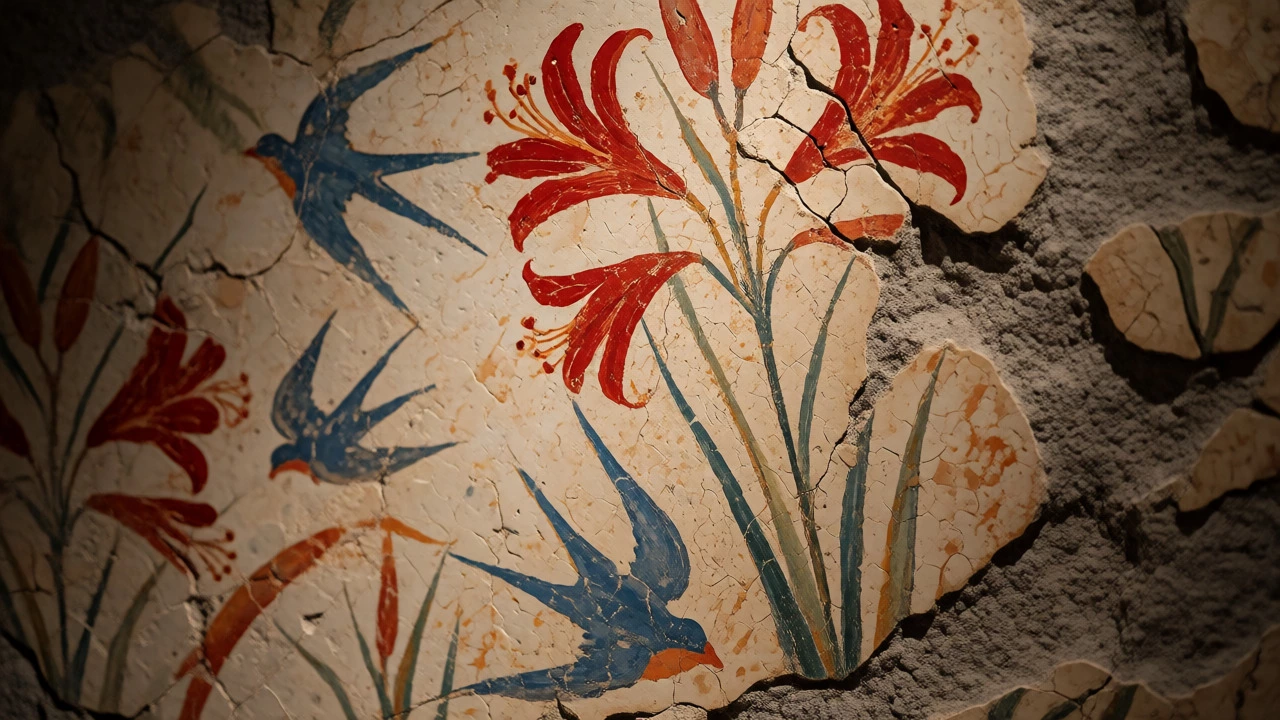
Most people assume landscape art began with the Renaissance Italians or the Dutch masters. They’d be wrong by about two thousand years. The earliest contenders for the title of oldest landscape painting come from the Minoan civilization on the island of Crete. Specifically, the frescoes found at Knossos and Akrotiri (on Santorini) date back to around 1600 BCE.
Why do these count? In earlier Egyptian or Mesopotamian art, nature was usually symbolic. A lotus flower meant rebirth; a palm tree meant Egypt. But in the Minoan fresco known as the Spring Fresco from Akrotiri, there are no humans, no gods, and no narrative action. There are only lilies, swallows, and rocks. The artist painted them because they liked how they looked. That shift-from symbolic representation to aesthetic observation-is the birth of true landscape sensibility.
The Akrotiri West House Frescoes, particularly the panel showing a river flowing through a valley with stylized hills and vegetation, is often cited by art historians as the closest thing we have to a proto-landscape from the ancient world. It depicts a specific geography, likely the island of Thera itself, rendered with a sense of depth and atmosphere that feels surprisingly modern.
China’s Long Tradition: Where Landscape Became Philosophy
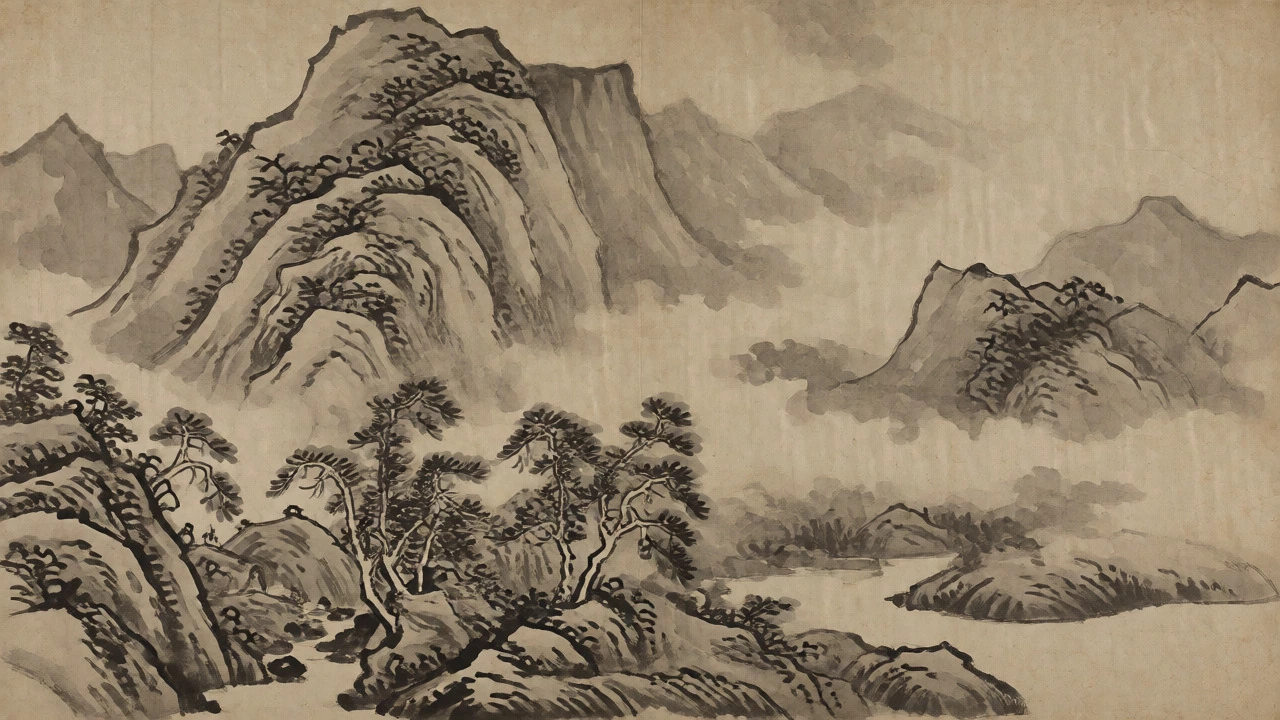
If the Minoans gave us the first glimpse, China gave us the first sustained tradition. While Western art spent centuries focusing on the human figure, Chinese artists elevated the natural world to a spiritual plane. The earliest surviving independent landscape paintings in China date to the Tang Dynasty (618-907 CE), but the theoretical foundations go back much further.
You might hear names like Zhan Ziqian mentioned in this context. He was a painter during the Sui Dynasty (581-618 CE). His work Strolling Out in Spring is traditionally credited as one of the earliest existing scrolls depicting a landscape scene. However, authenticity debates abound. Many scholars believe the extant version is a later copy, perhaps from the Song Dynasty. Still, it represents the early formalization of Shan Shui (mountain-water) painting, where nature isn’t just a backdrop but the main character.
Unlike the static snapshots of Minoan frescoes, Chinese landscapes invited the viewer on a journey. You didn’t just look at the mountain; you mentally walked through the misty valleys. This concept, called woyou (reclining while traveling), transformed landscape painting into a meditative practice long before Europe caught up.
Roman Realism: The Gardens of Pompeii
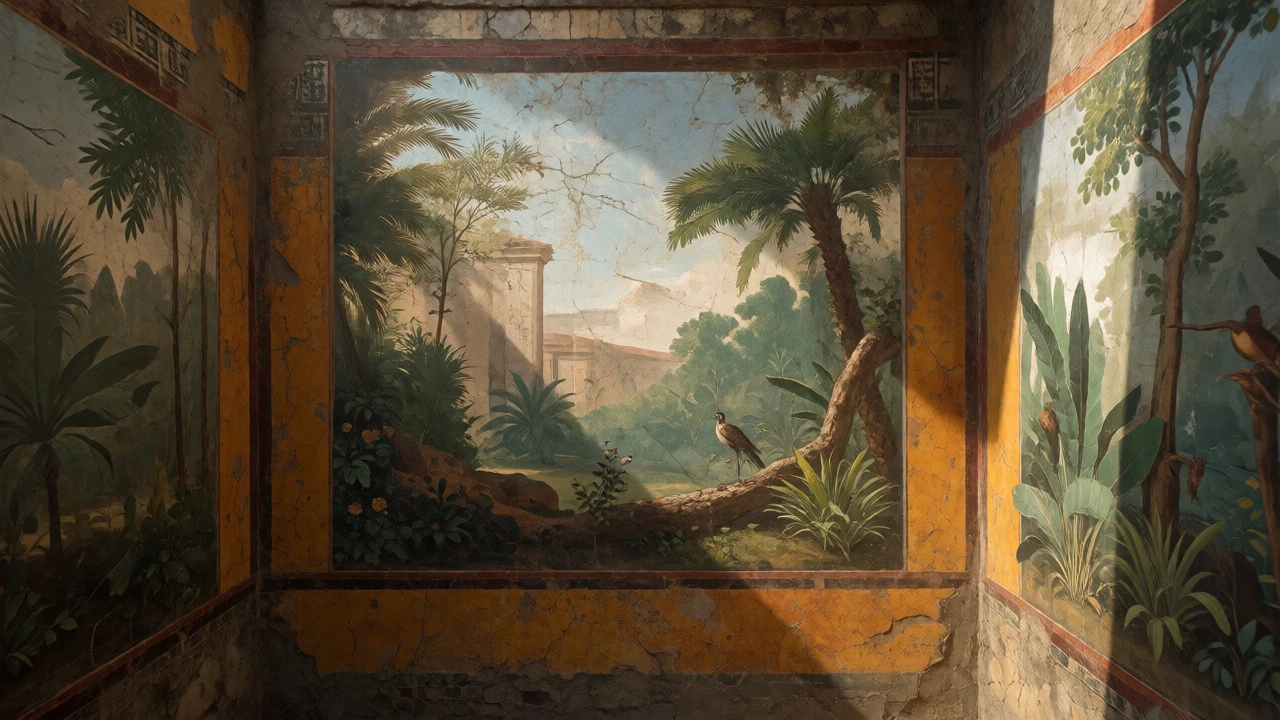
Between the Minoans and the Chinese Tang Dynasty, Rome played a crucial role. Roman wall paintings, especially those preserved in Pompeii and Herculaneum (buried in 79 CE), show a fascination with illusionistic landscapes. These aren’t sacred spaces; they’re domestic decorations designed to make small rooms feel open and airy.
The Second Style of Roman frescoing featured elaborate garden scenes with birds, fountains, and distant architecture. While still serving a decorative function, these works demonstrated a keen eye for light, shadow, and perspective. They proved that Romans could render three-dimensional space on a flat wall, a technical skill that would eventually feed into the European landscape tradition.
Comparing the Contenders
To understand why there’s no single winner, we need to look at what defines a "landscape." Is it a picture of land? Or is it a genre with its own rules?
| Civilization/Era | Example Work | Date (Approx.) | Key Characteristic | Status |
|---|---|---|---|---|
| Minoan (Crete/Santorini) | Spring Fresco / River Scene | 1600 BCE | Nature as primary subject; no human figures | Proto-Landscape |
| Han Dynasty (China) | Relief Carvings & Tomb Murals | 206 BCE - 220 CE | Symbolic elements; emerging spatial depth | Early Development |
| Roman (Pompeii) | Garden Frescoes | 1st Century CE | Illusionistic depth; decorative intent | Decorative Landscape |
| Tang Dynasty (China) | Attributed to Zhan Ziqian | 6th-7th Century CE | Independent scroll painting; philosophical depth | Classical Landscape |
| Carolingian/Renaissance (Europe) | Various Altarpieces | 8th-15th Century CE | Backgrounds gradually gaining prominence | Emerging Genre |
Why Definition Matters
If you define landscape strictly as "a painting where nature is the sole focus," the Minoan frescoes win hands down. They predate everything else by over a millennium. But art historians often hesitate to call them "landscapes" in the traditional sense because they lack the compositional complexity and emotional resonance associated with the genre today.
Conversely, if you define it as "a developed artistic genre focused on the visual appreciation of nature," then the Chinese tradition takes the crown. By the 10th century, Chinese painters had codified rules for composition, brushwork, and ink wash that allowed them to capture the spirit of the land, not just its appearance. This approach influenced Japanese art and eventually filtered into Western Romanticism.
There’s also the issue of survival. Paintings rot. Paper decays. Plaster crumbles. We only know what survived by accident. The Minoan frescoes survived because volcanic ash buried Akrotiri. Chinese scrolls survived because they were carefully stored in silk boxes. If a similar tradition existed in Africa or the Americas using perishable materials, we might never know.
The Role of Technology and Materials
You can’t talk about old paintings without talking about what they’re made of. The Minoans used wet lime plaster (fresco secco techniques varied), which bound pigments chemically to the wall. This durability helped preserve images for millennia. In contrast, early Chinese landscapes were often painted on silk, which is fragile. Many early works exist only as copies made centuries later.
This material difference shapes our perception. When you see a Roman fresco, you’re seeing the original surface. When you see a "Tang Dynasty" landscape, you’re often looking at a Song Dynasty copy of a Tang original. Does that disqualify it? Not necessarily. It shows a continuous lineage of interest in landscape that persisted through generations.
How to Spot an Ancient Landscape Today
If you visit museums like the British Museum in London or the National Archaeological Museum in Athens, keep an eye out for fragments labeled "Minoan" or "Cycladic." Look for:
- Absence of Humans: If the focus is entirely on plants, animals, or terrain, it’s a strong candidate for early landscape interest.
- Stylized Natural Forms: Ancient artists rarely captured photorealism. Look for rhythmic patterns in leaves or geometric representations of mountains.
- Spatial Ambiguity: True perspective came later. Early landscapes often flatten depth, placing foreground and background on the same plane.
For Chinese art, head to galleries specializing in Asian art. Look for handscrolls that invite you to unroll them slowly. Notice how the path winds through the mountains, guiding your eye rather than forcing a single viewpoint. This dynamic viewing experience is a hallmark of mature landscape traditions.
Final Thoughts on Our Earliest Views
So, who holds the title? For raw age and independence from human narrative, the Minoan frescoes of 1600 BCE stand alone. They prove that thousands of years ago, humans looked at a field of lilies and thought, "This is beautiful enough to paint." For sophistication and cultural impact, the Chinese Shan Shui tradition offers the deepest roots of landscape as a philosophical and artistic discipline.
Next time you look at a photo of a mountain range, remember: someone drew a line on a cave wall or mixed pigment on plaster to tell you, "Look here. See this? Isn’t it grand?" That impulse connects you directly to the anonymous artist at Akrotiri, four thousand years ago.
Is the Mona Lisa considered a landscape painting?
No, the Mona Lisa is a portrait. However, the atmospheric landscape behind her is significant because Leonardo da Vinci used sfumato to create depth, influencing how later artists treated backgrounds. It’s not a landscape genre piece, but it features advanced landscape rendering.
Why don’t we have older landscape paintings from Egypt?
Egyptian art was highly functional and symbolic, focused on religious rituals and the afterlife. Nature was depicted symbolically (e.g., papyrus for Lower Egypt) rather than for aesthetic appreciation. While tomb walls show gardens and pools, they served ritual purposes, not purely scenic ones, so they aren’t classified as independent landscape paintings.
Can I see the Minoan Spring Fresco in person?
Fragments of the Spring Fresco from Akrotiri are housed in the National Archaeological Museum of Athens, Greece. Some reproductions and smaller fragments may be displayed in other major museums, but the originals are protected in climate-controlled environments due to their fragility.
What is Shan Shui?
Shan Shui literally translates to "mountain-water." It is a style of Chinese landscape painting that emerged as a distinct genre during the Tang Dynasty and flourished in the Song Dynasty. It emphasizes capturing the spirit of nature through ink and brush, rather than realistic detail, often incorporating Daoist and Buddhist philosophies.
Did ancient Greeks paint landscapes?
Ancient Greek texts mention famous painters who created illusionistic landscapes, such as Apollodorus and Zeuxis. However, very few actual Greek panel paintings survive. Most knowledge comes from literary descriptions or Roman copies of Greek works. Therefore, while Greeks likely painted landscapes, we cannot point to a specific surviving Greek landscape painting as definitively as we can with Minoan frescoes.
