Abstract Art Quality Checker
Is This Abstract Art Good or Bad?
Use this tool to assess abstract paintings based on the criteria discussed in the article. Check all that apply to the artwork you're evaluating.
Abstract art doesn’t have to be pretty. It doesn’t have to make sense. But it does have to mean something. And that’s where most people get fooled. You walk into a gallery, see a splatter of paint on a canvas, hear someone say, "This is genius," and you nod along-even though you have no idea why. That’s not appreciation. That’s peer pressure. So what actually makes abstract art bad? It’s not about skill. It’s not about technique. It’s about intent, depth, and honesty.
Bad abstract art has no reason to exist
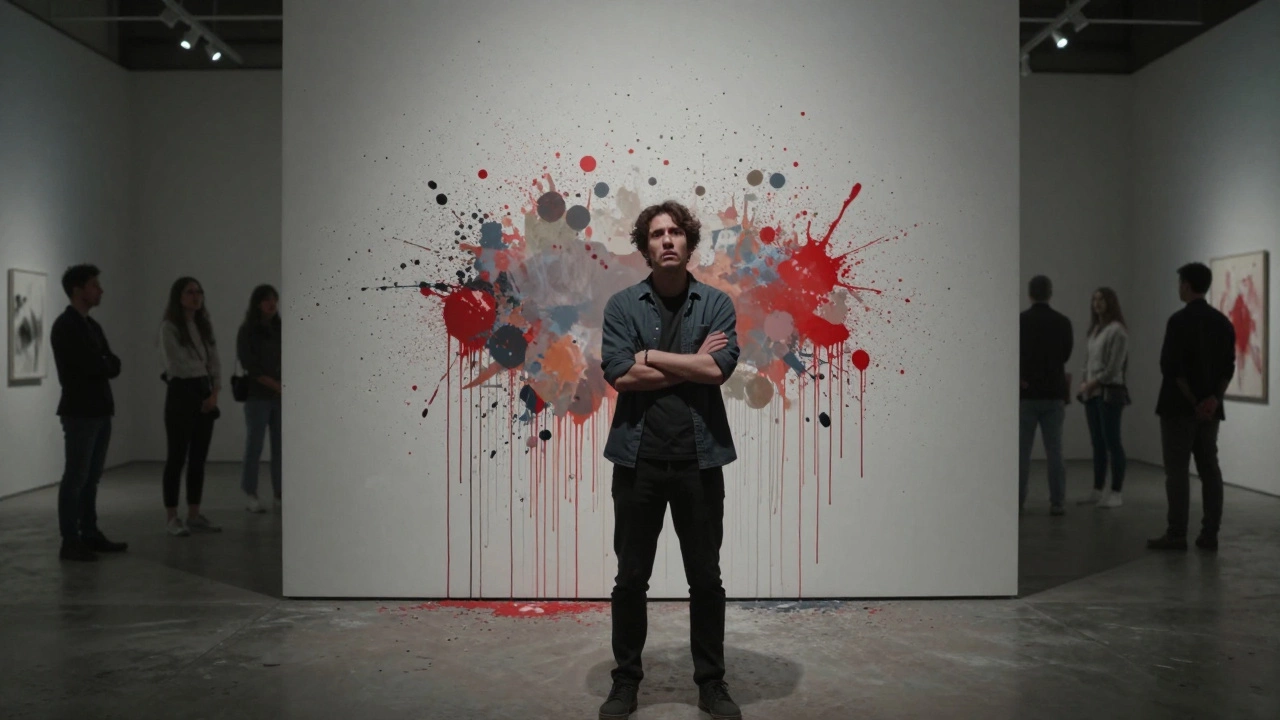
The worst abstract paintings are the ones that look like a child’s finger painting after a tantrum. And honestly? Sometimes they are. But here’s the thing: a toddler’s scribble can be charming. An adult’s splatter, with no purpose, is just lazy. Bad abstract art doesn’t ask a question. It doesn’t challenge. It doesn’t evoke. It’s just noise dressed up as meaning.
Think of it like music. If someone slams their fist on a piano and calls it a composition, you’d laugh. Yet we do this all the time with visual art. A canvas covered in random drips and streaks isn’t abstract-it’s accidental. Good abstract art doesn’t hide behind randomness. It uses it intentionally. Bad abstract art mistakes chaos for control.
It copies style without understanding
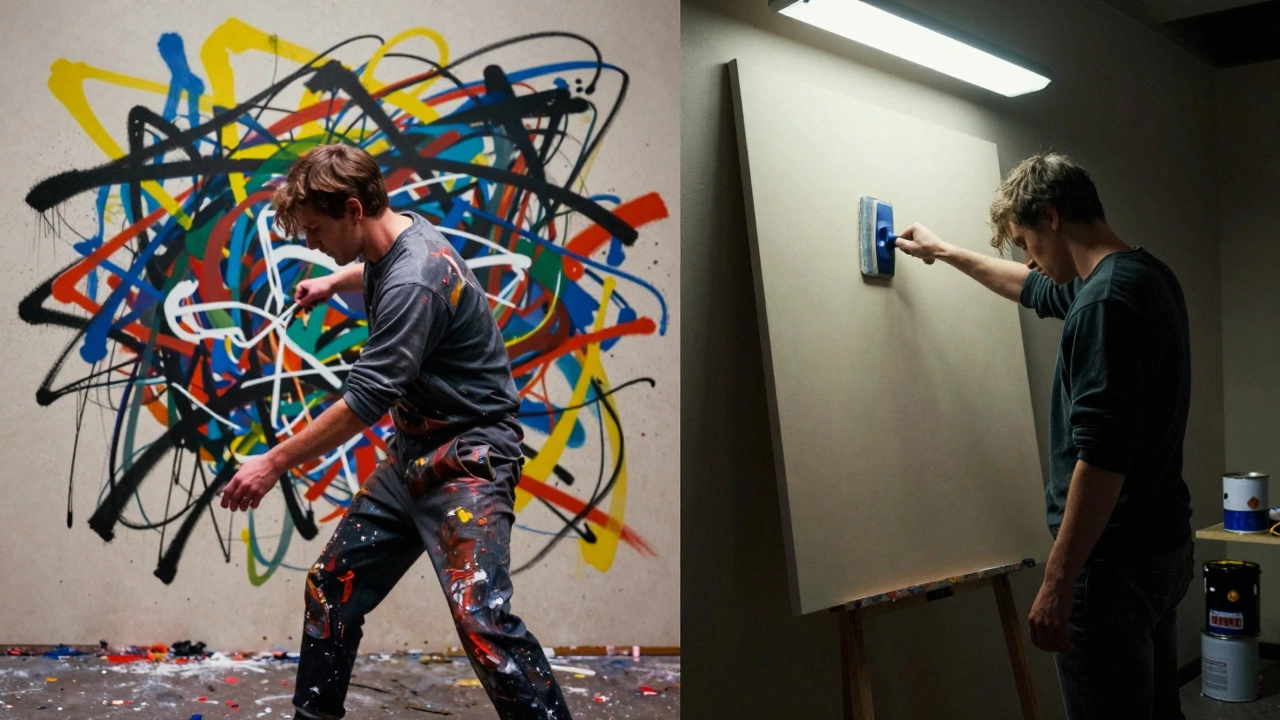
Pollock’s drip paintings? Groundbreaking. Not because he flung paint. But because he was exploring movement, gravity, and emotion. He studied Native American sand paintings. He was influenced by Jungian psychology. He spent years refining his process. Now, you see artists who copy the look-no context, no research, no personal struggle. They buy industrial paint, lay a canvas on the floor, and throw some colors. Then they call it "expressive."
That’s not art. That’s performance art without the performance. It’s like someone learning to play guitar by watching a rock star smash a guitar on stage-and then thinking they’ve mastered music because they broke a string.
No emotional or intellectual weight
Good abstract art makes you feel something you can’t name. Maybe it’s unease. Maybe it’s calm. Maybe it’s nostalgia for a place you’ve never been. Bad abstract art feels like wallpaper. It doesn’t linger. It doesn’t haunt. It doesn’t change how you see the world.
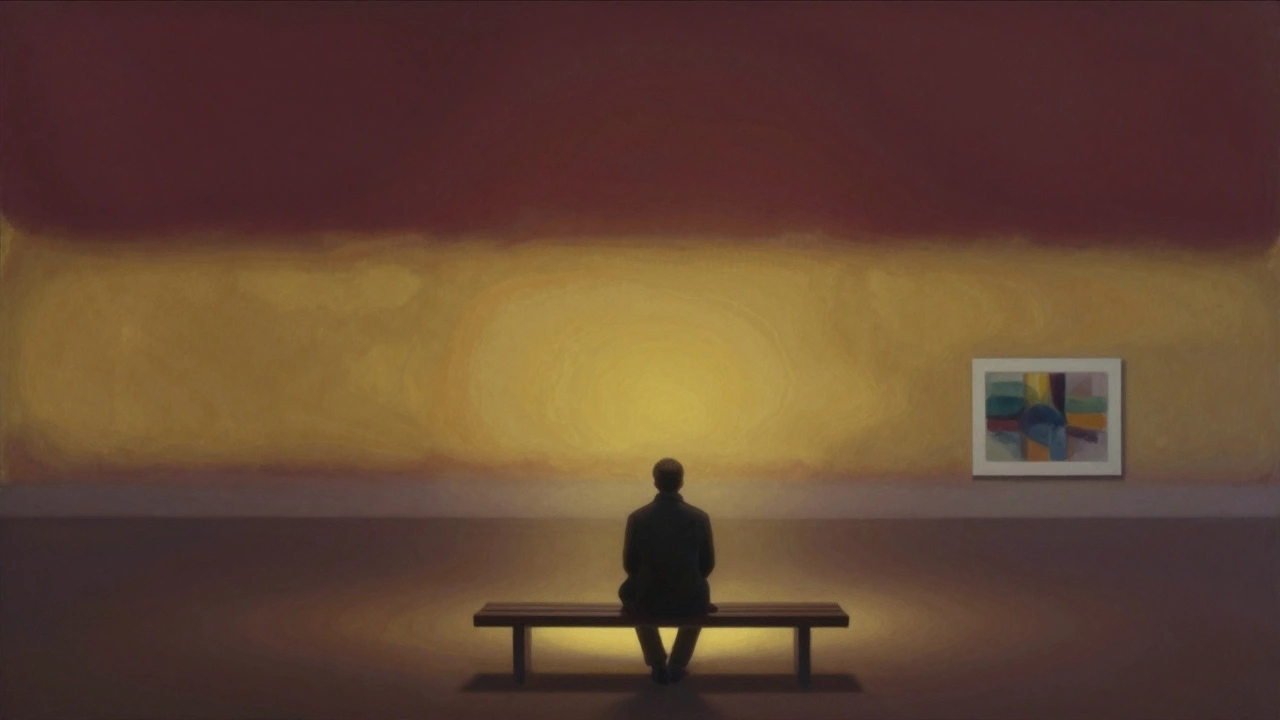
Look at Mark Rothko’s color fields. They’re simple: rectangles of paint. But people have cried in front of them. Why? Because Rothko was trying to capture the sublime-the feeling of being small in a vast universe. He worked for months on a single canvas, layering thin glazes until the color seemed to glow from within.
Now compare that to a canvas you might see at a mall art fair: three bold strokes, a splash of neon, and a price tag of $800. No depth. No history. No struggle. Just branding.
It’s all about the title
Bad abstract art needs a fancy name to feel important. "Echoes of the Fifth Dimension," "Whispers of the Unseen Soul," "The Silence Between Stars." These aren’t titles. They’re excuses.
Good abstract art doesn’t need a poem for a name. If it’s strong, the title just points to it. Think of Barnett Newman’s "Vir Heroicus Sublimis." It’s Latin for "Man, Heroic and Sublime." No mysticism. No vagueness. Just a quiet statement that matches the painting’s scale and presence.
When you have to explain the art with a paragraph of jargon, you’re hiding the fact that the art itself says nothing.
It’s made for the market, not the mind
There’s a whole industry built around selling bad abstract art. Corporate offices. Hotel lobbies. Airbnb hosts. They want "bold," "modern," "conversation-starting." So they buy mass-produced "abstract" prints that look like they came from a factory in Guangzhou.
These pieces are designed to be ignored. They’re the visual equivalent of elevator music. They’re safe. They’re neutral. They’re designed to not offend. And that’s the death of real art.
Real abstract art is uncomfortable. It’s personal. It’s risky. It’s made by someone who had nothing to lose. Bad abstract art is made by someone who had everything to gain.
It ignores context
Abstract art doesn’t exist in a vacuum. It’s part of a conversation. It responds to history, politics, trauma, joy. Bad abstract art pretends it’s above all that. "I just paint what I feel." But what if what you feel is boredom? Or fear of being called out? Or the pressure to sell something?
Look at the work of Hilma af Klint. She started painting abstractly in 1906-years before Kandinsky. Her work was deeply spiritual, rooted in Theosophy, and made as a bridge between science and mysticism. She didn’t show it publicly for decades because she knew the world wasn’t ready.
Compare that to an artist today who paints abstract shapes because they saw a TikTok trend. No context. No legacy. No risk. Just trend-chasing.
It’s all surface, no structure
Even the wildest abstract art has structure. Composition. Rhythm. Balance. Tension. Good abstract artists use these like a composer uses harmony and dissonance. Bad abstract artists treat the canvas like a blank wall to spray-paint.
Look at the difference between a Willem de Kooning and a random Instagram artist. De Kooning’s "Woman" series is chaotic, yes-but every stroke has a purpose. The brushwork has weight. The color choices have emotional logic. You can feel the hand behind it.
Bad abstract art looks like it was made in five minutes. With a squeegee. While watching Netflix.
It’s not about the price
Just because something costs $50,000 doesn’t make it good. And just because it costs $20 doesn’t make it bad. But if the only reason you’re paying that price is because someone told you it’s "important," you’re being sold a lie.
Ask yourself: If this painting had no title, no artist name, no gallery label-would you still stop and stare? Would you feel something? Would you come back to it?
If the answer is no, then it’s not bad because it’s ugly. It’s bad because it’s empty.
What makes good abstract art?
It’s not about how hard it was to make. It’s about how hard it is to forget.
Good abstract art leaves a mark. It doesn’t shout. It whispers. It lingers in your chest. It changes how you look at color, space, or even silence.
It’s made by someone who had something to say-and wasn’t afraid to say it without words.
How to tell if you’re looking at bad abstract art
- You can’t describe what you feel after 30 seconds of looking.
- The artist gives a long explanation that sounds like a TED Talk written by a chatbot.
- The piece looks like it could be made by a machine or a toddler.
- You’ve seen the same style in ten other galleries.
- The title is more interesting than the painting.
- It was bought by a corporation, not a collector.
- The artist has no other body of work that shows growth or depth.
Trust your gut. If it feels like a scam, it probably is.