
Note-to-Color Explorer
Explore how different systems map musical notes to colors. Click a note card to hear its pitch and see the associated color.
Selected Note Details
Frequency: -- HzNote: --
Associated Color: --
Rationale: Select a note above to view details.
You’re sitting at a piano. You press the middle C. To most people, it’s just a sound-a specific frequency of vibration around 261.63 Hz. But for some, that note isn’t silent in the visual sense. It might look like a crisp white light, or perhaps a deep red circle floating in the air. This isn’t imagination; it’s a neurological reality called synesthesia. The question "What color is the note C?" doesn't have one universal answer because it depends entirely on who you ask: a physicist, a painter, or someone with a brain wired to cross-wire senses.
If you’ve ever wondered why some musicians swear certain keys are "blue" while others feel "gold," you’re touching on a centuries-old debate about how we perceive sound. Let’s break down the science, the art, and the weirdness of mapping notes to colors.
The Short Answer: There Is No Universal Color
Here is the hard truth upfront: In standard Western music theory, musical notes do not have inherent colors. A note is a frequency. A color is a wavelength of visible light. They exist on different parts of the electromagnetic spectrum. Sound waves travel through air as pressure changes; light travels as photons. Physically, they don’t mix.
So why does this question persist? Because humans love patterns. We try to organize chaos. For centuries, artists and scientists have tried to create a "color organ" or map the musical scale onto the rainbow. These systems are arbitrary but fascinating. If you look at a standard piano keyboard, the white keys (natural notes) and black keys (sharps/flats) are literally colored black and white. That’s the only objective color association in instrument design.
But outside the physical instrument, the color of "C" is subjective. It lives in the mind of the listener. And for a small percentage of the population, it’s vividly real.
Synesthesia: When Sounds Have Colors
Chromesthesia, also known as sound-to-color synesthesia, is a condition where hearing a specific tone automatically triggers a visual experience of color. This isn’t a metaphor. People with chromesthesia actually see shapes and hues when they hear music.
For these individuals, the color of the note C is consistent every time they hear it. However-and this is the kicker-it varies wildly from person to person. One synesthete might see C as bright yellow. Another might see it as dark purple. There is no consensus. Studies suggest that the specific color often correlates with the perceived "brightness" or "darkness" of the pitch, but even that link is weak.
Why does this happen? Neurologists believe it stems from cross-activation between the auditory cortex and the visual cortex in the brain. During development, neural pathways that usually stay separate remain connected. So when your ear hears a C-sharp, your eye lights up with orange. It’s a glitch in the wiring, but a beautiful one. Famous composers like Olivier Messiaen and Alexander Scriabin experienced this, influencing their compositions to reflect their internal color palettes.
Historical Attempts to Map Music to Color
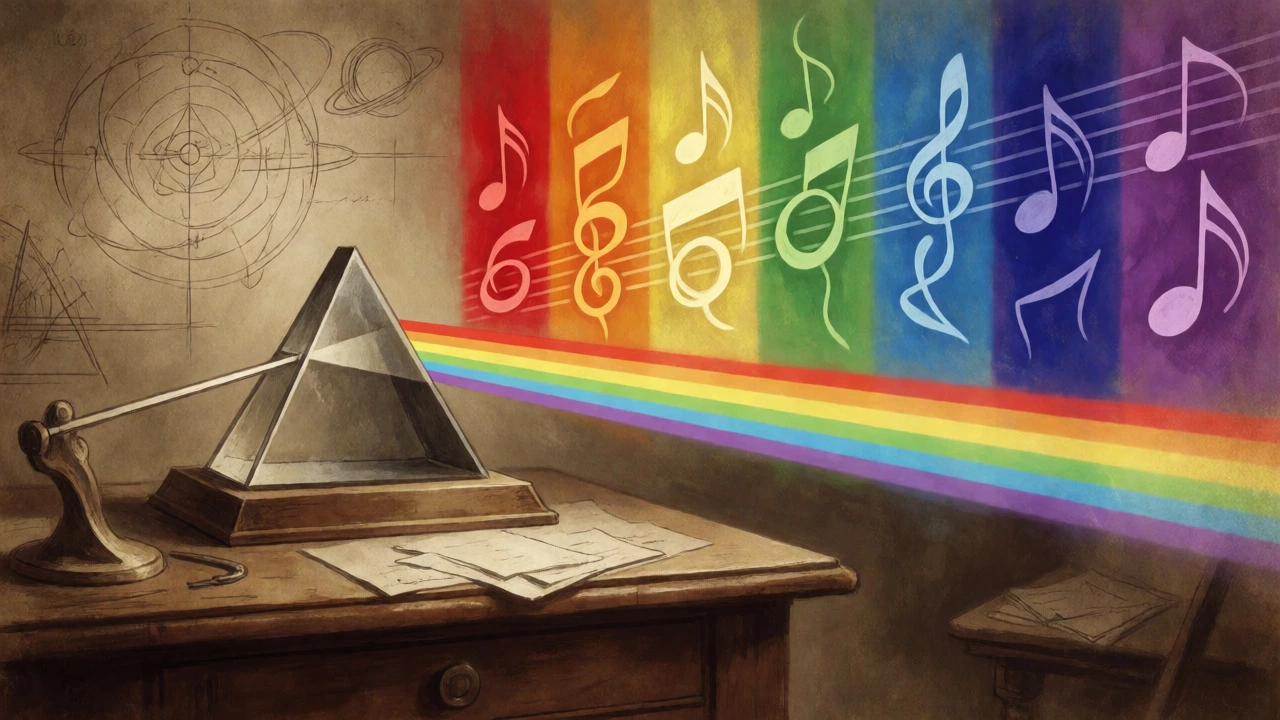
Before we had neuroscience, we had philosophy and optics. Isaac Newton famously associated the seven notes of the major scale with the seven colors of the rainbow. He believed there was a natural harmony between light and sound. In his system:
- C was Red
- D was Orange
- E was Yellow
- F was Green
- G was Blue
- A was Indigo
- B was Violet
This mapping is purely aesthetic. Newton wanted to match the seven days of the week, the seven planets, and the seven colors of light. It wasn’t based on acoustic physics. Yet, this idea stuck. Many modern educational tools use similar rainbow mappings to teach children scales. If you grew up using a "rainbow piano" app, you likely learned that C is red. But if you ask a professional musician, they might disagree entirely.
Other systems, like those proposed by Louis-Bertrand Castel in the 18th century, tried to build actual instruments that projected light according to pitch. His "ocelinharmonic" used oil lamps and colored glass. The colors were assigned based on the complexity of the frequency ratios, not any natural law. Today, digital audio workstations (DAWs) allow producers to assign custom colors to MIDI notes, creating personalized visual maps for workflow efficiency rather than perceptual accuracy.
Why Do Musicians Talk About "Blue" Notes?
You’ll often hear jazz musicians talk about "blue notes." This has nothing to do with synesthesia. In music theory, a blue note is a note sung or played at a slightly lower pitch than that of the major scale for expressive purposes. Typically, it’s the third, fifth, or seventh degree of the scale flattened by a semitone or microtone.
The term "blue" here refers to melancholy or sadness, derived from African American slang where "blue" meant sad or depressed. So, when a saxophonist bends a B-flat into a blue note, they aren’t seeing a blue hue; they’re evoking an emotion. This linguistic overlap confuses many beginners. Don’t confuse emotional descriptors with visual perceptions.
Practical Applications: Should You Assign Colors to Notes?
If you don’t have synesthesia, should you bother assigning colors to notes? Yes, if it helps you learn. Visual aids can reinforce memory. Many students find that associating each key with a color creates a stronger mental hook. Here is a popular, intuitive mapping based on the "warmth" of the pitch range:
| Note | Common Association | Rationale |
|---|---|---|
| C | White or Red | White for purity/start; Red for energy/root. |
| D | Orange | Warm, rising energy. |
| E | Yellow | Bright, happy, major tonality. |
| F | Green | Natural, stable, earthy. |
| G | Blue | Cool, resolving, sky-like. |
| A | Indigo/Violet | Mysterious, minor tendency. |
| B | Purple/Pink | Tense, leading tone, high energy. |
This table is just a suggestion. Try it out. Play a C major chord. Does it feel white to you? Clean? Or does it feel red, powerful? Trust your gut. Your brain creates its own logic. Consistency matters more than correctness. If you decide C is green, stick with it. Changing your mental map mid-learning will only cause confusion.

The Physics Angle: Frequency vs. Wavelength
Let’s get nerdy for a second. Could there be a scientific basis for color-note mapping? Some theorists have tried to align the octave ratio (2:1) with the visible light spectrum. The visible spectrum ranges roughly from 400 THz (violet) to 790 THz (red). The audible range is 20 Hz to 20 kHz. These numbers don’t line up neatly.
If you take Middle C (261.6 Hz) and multiply it by powers of two until you reach the optical range, you land somewhere in the infrared or ultraviolet, depending on your starting point. There is no mathematical constant that forces C to be red. Any claim that "C is physically red" is pseudoscience. The connection is psychological, not physical.
How to Test Your Own Perception
Want to know what color C is for you? Try this simple experiment. Close your eyes. Listen to a pure sine wave tone of Middle C. Don’t think about the letter name. Just listen. What comes to mind? A shape? A temperature? A color?
Now listen to a higher C (one octave up). Did the color change? Did it get brighter or smaller? Repeat with other notes. Keep a journal. Over a week, you might discover a personal palette. This process is called "active listening." It enhances your musical sensitivity regardless of whether you have true synesthesia. Most people report vague associations-"high notes feel light," "low notes feel heavy." Translating "heavy" to "dark blue" is a creative leap, but a useful one for composition.
Remember, there is no wrong answer. If you see C as neon green, that’s valid. If you see it as nothing, that’s normal too. The magic of music lies in its abstraction. We turn invisible vibrations into emotions, stories, and sometimes, imaginary colors.
Is there a scientific reason for linking notes to colors?
No, there is no direct scientific link between specific frequencies and visible light wavelengths. Sound and light are different physical phenomena. Historical attempts to link them, like Newton's, were based on numerology and aesthetics, not physics. Modern neuroscience attributes color-sound links to synesthesia, a neurological condition involving cross-wiring in the brain.
Do all musicians see colors when they hear music?
No. Only a small percentage of the population has chromesthesia (sound-to-color synesthesia), estimated at less than 1% to 5%. Most musicians use color metaphors emotionally (e.g., "bright" tone, "dark" mood) but do not actually see colors when hearing notes.
Why did Isaac Newton associate C with red?
Newton mapped the seven notes of the diatonic scale to the seven colors of the rainbow to create a harmonious system that aligned with religious and philosophical beliefs about the number seven. He started with C as red arbitrarily to fit the sequence, not because of any acoustic property of the note itself.
Can I train myself to see colors for notes?
You cannot develop true synesthesia later in life if you weren't born with it, as it involves structural brain differences. However, you can train yourself to use color coding as a mnemonic device. By consistently associating specific colors with specific notes, you can improve your ability to visualize musical structures and enhance your compositional workflow.
What color is middle C on a piano?
Physically, middle C is played on a white key. Therefore, its literal color is white. However, in educational contexts or software interfaces, it may be highlighted in various colors depending on the application's design scheme, such as red for the root note in chord visualization tools.
