Portrait Painting Price Estimator
Use this tool to determine a competitive yet profitable price for your next commissioned portrait. Enter details below to see both Hourly Rate and Square Inch formula estimates.
Commission Details
You’ve just finished a stunning portrait painting that took you three weeks of intense labor. You look at the canvas, feeling proud but also terrified. How much do you charge? If you say £150, you might feel cheated. If you say £1,500, your client might walk away. This paralysis is common among artists, yet it’s one of the biggest barriers to turning a hobby into a sustainable career.
Pricing isn't just about covering paint costs; it's about valuing your time, skill, and market position. Whether you are a student in Bristol or a seasoned professional selling to collectors in London, getting this right changes everything. It stops you from undercharging and burning out, and it helps serious buyers trust your work enough to pay for it. Here is how to calculate a price that feels fair to you and attractive to them.
The Hourly Rate Method: Your Baseline
Most beginners start here because it feels logical. You track every hour spent sketching, mixing colors, painting, and varnishing. Then you multiply those hours by an hourly rate. But what is a good hourly rate for an artist?
Don’t use minimum wage as your baseline unless you’re just starting out with zero reputation. In the UK, a reasonable starting point for a skilled freelance artist is often between £15 and £30 per hour. Why so high? Because you aren't just paid for painting. That rate must cover materials, studio rent, marketing, taxes, insurance, and the time you spend not painting (admin, emails, sourcing frames).
Let’s say a half-body oil portrait takes you 20 hours. At £20/hour, that’s £400. Add £50 for canvas, oils, and brushes. Your base price is £450. This method ensures you don’t lose money on complex pieces. However, it has a flaw: it doesn’t account for your fame or demand. A famous artist might charge £500 per hour, while a beginner might struggle to sell at £10. Use this as your floor, not your ceiling.
The Square Inch Formula: The Industry Standard
If hourly tracking makes you anxious, try the square inch formula. This is widely used in galleries and online platforms like Saatchi Art or Etsy. The logic is simple: bigger paintings require more effort and presence, so they should cost more.
The basic formula looks like this:
- Price = Width (inches) x Height (inches) x Multiplier
What is the multiplier? This is where your experience comes in. For emerging artists, a multiplier of £1 to £3 per square inch is common. For established artists, it can jump to £5-£10+.
Imagine you painted a 16x20 inch portrait. That’s 320 square inches. Using a modest multiplier of £2, your price would be £640. If you use £1, it’s £320. Notice how quickly small size differences impact price? A 12x16 piece (192 sq inches) at £2/sq inch is only £384. This method rewards scale, which aligns with how people hang art-they expect larger focal points to cost more.
| Size (Inches) | Square Inches | Emerging Artist (£1.50/sq in) | Mid-Level Artist (£3.00/sq in) | Established Artist (£6.00/sq in) |
|---|---|---|---|---|
| 8 x 10 | 80 | £120 | £240 | £480 |
| 16 x 20 | 320 | £480 | £960 | £1,920 |
| 24 x 36 | 864 | £1,296 | £2,592 | £5,184 |
Accounting for Complexity and Medium
Not all portraits are created equal. A quick charcoal sketch of a face is different from a hyper-realistic oil painting of a family group. You need to adjust your base price based on difficulty.
Consider these factors:
- Number of Subjects: One person is standard. Two people add 20-30% to the price. Three or more? Charge per head plus a complexity fee.
- Medium: Oil paints are expensive and slow-drying. Acrylics are faster and cheaper. Watercolors are unforgiving-mistakes ruin the whole sheet. Adjust your multiplier accordingly. Oils usually command higher prices than pastels due to material costs and drying time.
- Detail Level: Does the client want loose impressionistic strokes or photorealistic skin texture? Photorealism takes exponentially longer. If you promise realism, charge for the extra hours.
A practical rule of thumb: Add a 10-15% surcharge for each additional subject beyond the first. If a single-person portrait is £500, a couple’s portrait shouldn’t just be double; it should be around £1,100-£1,200 because of the compositional challenges and interaction between figures.
Know Your Market Position
Your price must match where you stand in the art world. Are you selling to friends who love your vibe, or to corporate offices needing decor? These are different markets.
Local Community Market: If you sell at local fairs in Bristol or through social media to friends, keep prices accessible. £100-£300 for small works is normal. Buyers here value connection over investment potential.
Online Global Market: Platforms like Etsy or Instagram reach everyone. Competition is fierce. You need competitive pricing but also strong branding. Mid-range prices (£300-£800) work well here if your presentation is professional.
Gallery Representation: If a gallery sells your work, remember they take a commission-usually 40-50%. If you want to pocket £1,000, the retail price must be £2,000. Always factor this in before agreeing to a gallery deal.
Check what similar artists charge. Look at their Instagram, website, or gallery listings. Don’t copy them exactly, but understand the range. If five artists with similar skills charge £400 for a 12x16 portrait, charging £1,200 will scare people off unless you have a unique selling point (like celebrity clients or awards).
The Psychology of Pricing
Numbers matter less than perception. A price of £495 feels significantly cheaper than £500, even though the difference is trivial. Use psychological pricing tricks wisely.
Also, never apologize for your price. When a client asks, "Why is it so expensive?", don’t say, "I’m sorry, I know it’s a lot." Instead, explain the value: "It includes three rounds of sketches, archival-quality oils, and four weeks of dedicated studio time." Confidence sells.
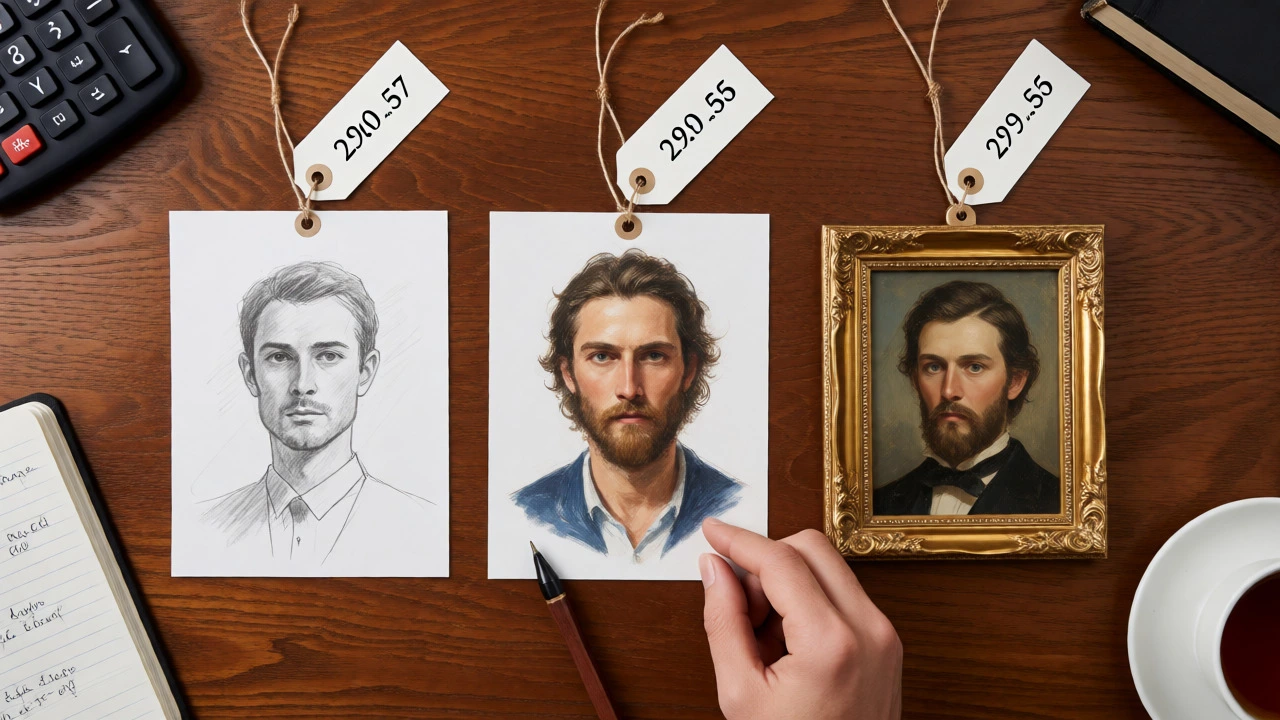
Offer tiers. Give clients options. For example:
- Basic Sketch: £150 - Pencil study, no color.
- Standard Portrait: £450 - Colored pencil or digital render.
- Deluxe Oil Painting: £900 - Full-size canvas, framed, shipped.
Most people pick the middle option. By anchoring with a high-end deluxe option, the standard price seems reasonable. This strategy increases average order value without forcing a hard sale.
Common Mistakes to Avoid
Stop doing these things if you want to grow as a professional artist:
1. Changing prices randomly. Pick a formula and stick to it for at least six months. Consistency builds trust. If you raise prices, announce it clearly: "New commissions start at £X from January 1st." 2. Ignoring shipping and framing. A £500 painting that costs £100 to frame and ship leaves you with £400. Quote all-inclusive prices or state clearly that framing is extra. Surprise fees kill sales.
3. Working for exposure. Unless you are building a portfolio for a specific niche, exposure doesn’t pay rent. If a client wants a discount, ask for something valuable in return, like permission to use the image in your marketing or a testimonial video.
4. Underpricing early work. Yes, your first paintings were rough. But if you sell them too cheap, you anchor yourself low forever. Clients will wonder why your new work costs more when the old stuff was dirt cheap. Raise prices gradually as your skill improves.
Putting It All Together: A Step-by-Step Workflow
When a client sends an inquiry, follow this checklist:
- Clarify Scope: Ask for reference photos, desired size, medium, and deadline.
- Estimate Hours: Be honest about how long it will take. Include communication time.
- Calculate Base Cost: Use the hourly method or square inch formula.
- Add Material Costs: Canvas, paints, packaging, postage.
- Apply Complexity Multiplier: Add % for multiple subjects or high detail.
- Round Up: Round to the nearest £50 or £100 for simplicity.
- Present Options: Offer a basic version and a premium version.
- Send Invoice: Include payment terms (e.g., 50% deposit upfront).
For example, a client wants a 12x16 acrylic portrait of their dog. You estimate 10 hours of work. Your rate is £20/hour = £200. Materials = £30. Total = £230. Round up to £250. Offer a black-and-white pencil version for £120. Send both quotes. Let them choose.
Frequently Asked Questions
Should I include framing in my portrait price?
It depends on your workflow. Including framing simplifies the process for the buyer and allows you to control the final presentation. However, custom framing is expensive and logistically tricky. Many artists quote the artwork only and recommend local framers. If you include it, ensure the price covers the frame, glass, matting, and increased shipping risk. Always specify whether the price is 'framed' or 'unframed' in your listing.
How do I handle revisions in commissioned portraits?
Set clear limits in your contract. Typically, two rounds of minor revisions are included in the base price. Major changes after the initial sketch approval may incur extra fees. Communicate this upfront: "This price includes two revision stages. Additional changes are billed at £X per hour." This protects you from endless tweaks while giving clients peace of mind.
Is it better to charge by the hour or by the piece?
Charging by the piece (fixed price) is generally better for artists. It rewards efficiency-if you finish a portrait in 10 hours instead of 20, you earn more per hour. Hourly billing penalizes speed and rewards slowness. Use hourly calculations internally to determine your fixed price, but present a flat fee to the client. They prefer knowing the total cost upfront.
What deposit percentage should I require?
A 50% non-refundable deposit is standard practice. This secures the client’s commitment and covers your initial material costs. The remaining 50% is due upon completion, before shipping. For very large or expensive commissions, consider a tiered payment schedule (e.g., 30% start, 30% mid-point, 40% final). Never ship the artwork until full payment is received.
How often should I raise my prices?
Review your prices annually or whenever your skill level noticeably improves. A 10-15% increase every year is reasonable to account for inflation and growing expertise. Announce price increases in advance, such as "Prices will increase by 10% on January 1st," to encourage current inquiries to book sooner. Sudden, unexplained hikes can confuse loyal customers.
