Gallery Sketching Suitability Checker
Select your current situation and equipment to check if you're ready to start sketching in the gallery.
1. Gallery Type
2. Your Equipment
3. Verdict & Advice
Ready to DrawAnalysis:
- Public galleries generally encourage observational drawing.
- Your pencil kit is quiet and clean, minimizing risk of damage.
Ever stood before a masterpiece, felt the urge to capture it with charcoal or pencil, then hesitated because you weren't sure if it was allowed? You’re not alone. Many artists, students, and casual visitors wonder whether sketching in galleries is welcome or a breach of etiquette. The short answer: it depends on the venue, the exhibition, and how you do it.
Most major public institutions-like the Wellington Museum, the Auckland Art Gallery Toi o Tāmaki, or the National Gallery of Victoria-actively encourage observational drawing. They view it as a form of deep engagement with the work. But “encouraged” doesn’t mean “unrestricted.” There are practical limits: no tripods in narrow aisles, no flash photography (which often applies to video recording too), and strict rules about touching walls or frames. Understanding these boundaries turns a potentially awkward moment into a productive creative session.
Why Galleries Allow Drawing (and When They Don’t)
Public art galleries exist to educate and inspire. Sketching helps visitors process visual information, remember details, and connect emotionally with the artwork. Curators often see drawing as a sign of genuine interest rather than disruption. In fact, many institutions host free “draw with us” sessions where professional illustrators lead groups through specific collections.
However, private galleries, pop-up exhibitions, or temporary installations may have stricter rules. Why? Space constraints, fragile works, or high-value pieces that require controlled environments. If a gallery displays delicate textiles, light-sensitive paintings, or interactive digital art, they might prohibit any tools that could cause accidental damage or distraction. Always check the entrance signage or ask a docent before unpacking your kit.
The Unspoken Rules of Gallery Etiquette
Even when drawing is permitted, certain behaviors can annoy other visitors or staff. Here’s what seasoned sketchers know:
- Stay mobile. Don’t plant yourself in front of a single piece for over 15-20 minutes unless there’s a designated seating area. Rotate your focus to let others enjoy the space.
- Avoid blocking sightlines. Position yourself at an angle so you don’t obstruct views for people standing behind you.
- Keep noise low. No loud page-turning, aggressive erasing, or chatting while sketching. Treat the gallery like a library.
- Respect “Do Not Touch” zones. Even if you’re not touching the art, leaning against walls or sitting on plinths can damage surfaces or create safety hazards.
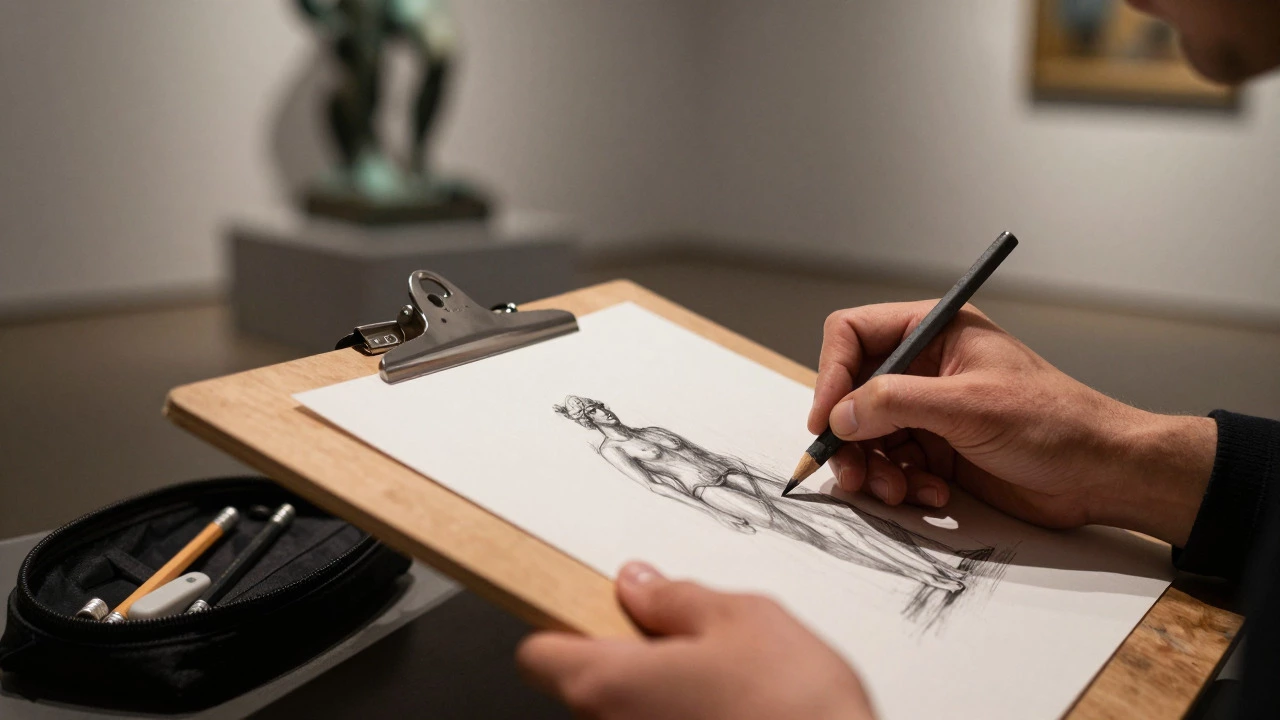
- Carry a compact kit. Large easels or bulky portfolios draw attention. A small pad, pencils, and a portable board keep your profile low and respectful.
Tools That Work Best in Gallery Settings
Your equipment should be quiet, clean, and easy to manage. Wet media like watercolor or ink risks smudging, dripping, or drying time issues that slow you down. Dry media are safer and more forgiving.
| Tool Type | Pros | Cons | Best For |
|---|---|---|---|
| Pencil (HB-4B) | Quiet, erasable, versatile | Limited tonal range without layering | Quick studies, line work |
| Charcoal | Rich blacks, expressive marks | Messy, requires blending tools | Dramatic lighting, texture |
| Micron Pens | Crisp lines, permanent | No erasing, limited weight variation | Architectural details, patterns |
| Graphite Sticks | Smooth application, wide range | Smudges easily without protection | Tonal shading, soft forms |
Bring a small portfolio or clipboard with a non-slip backing. Avoid using tape to secure paper-it can leave residue on gallery floors or seats if you set your kit down. A zippered pouch keeps stray graphite from scattering.
How to Choose What to Draw
You don’t need to replicate every piece in the room. Instead, look for elements that challenge or intrigue you. Is it the way light hits a bronze sculpture? The repetitive pattern in a textile? The negative space around a minimalist painting? Focusing on one aspect turns overwhelming complexity into manageable practice.
Try this exercise: pick three objects in the current exhibition and spend five minutes on each. First, draw only the outlines. Second, add basic values (light and dark). Third, refine one detail you find most interesting. This structured approach prevents paralysis and builds confidence quickly.
Common Mistakes to Avoid
New sketchers often make predictable errors that undermine their experience:
- Trying to copy perfectly. Observational drawing is about interpretation, not replication. Embrace imperfection.
- Ignoring scale relationships. Compare sizes between objects before committing to strokes. Misjudging proportions is the most common beginner error.
- Working too fast or too slow. Rushed sketches lack observation; overly deliberate ones disrupt flow. Aim for balanced pacing.
- Forgetting to hydrate and move. Galleries can be dry and still. Take breaks, stretch, and sip water to maintain focus.
When to Ask Permission
Some situations require explicit consent. If you plan to use a tripod, take long-form photos alongside your sketch, or create a large-scale piece, speak to staff first. Also, if the exhibition features living artists’ recent works, some creators prefer viewers engage passively out of respect for the piece’s emotional weight. A quick question like, “Is it okay to sketch here?” shows consideration and opens the door to helpful tips from knowledgeable staff.
Can I draw in any art gallery?
Most public galleries allow drawing, but private spaces, temporary exhibits, or fragile installations may restrict it. Check signage or ask staff before starting.
What tools are best for sketching in a gallery?
Dry media like pencils, charcoal, and micron pens are ideal. They’re quiet, clean, and require no drying time. Avoid wet paints or markers that could drip or bleed.
How long can I stay in front of one artwork?
There’s no universal limit, but staying under 15-20 minutes per piece is courteous. Rotate your focus to allow other visitors access and maintain gallery flow.
Do I need permission to draw in a museum?
Usually not for standard sketching. However, if using tripods, large boards, or working during special events, ask staff first to ensure compliance with venue policies.
Is drawing better than photographing art?
Drawing forces slower observation and personal interpretation, which deepens understanding. Photos capture exact details but may bypass active engagement. Many artists combine both methods for comprehensive study.