Painter Terminology: Essential Terms Every Artist and Buyer Should Know
When you hear someone say painter terminology, the specific language artists use to describe how they make art. Also known as artistic vocabulary, it’s not just jargon—it’s the key to understanding what’s really going on in a painting. If you’ve ever looked at a canvas and wondered why one brushstroke looks alive while another feels flat, it’s not magic. It’s technique. And technique has names.
Take oil painting, a slow-drying medium that lets artists blend colors directly on the canvas. It’s not just "paint on canvas." Oil lets you layer, glaze, scrape, and build texture over days. That’s why Van Gogh’s Starry Night has those thick, swirling ridges—it wasn’t slapped on. It was built. Then there’s acrylic painting, a fast-drying, water-based medium popular for its versatility and bold colors. Artists use it for quick sketches, large murals, or mixed media because it dries in minutes, not weeks. And then there’s brushwork, how the brush moves across the surface to create texture, rhythm, and emotion. A single stroke can be soft and blurred, or sharp and jagged—each choice tells a story.
These terms aren’t just for artists. Buyers who understand them see more than pretty colors. They see intention. When someone says a piece has "heavy impasto," they’re not being fancy—they’re saying the paint is thick, raised, almost sculpted. That matters. It affects value, preservation, and how the light hits the surface. Same with painting medium, the liquid mixed with pigment to change how paint behaves. Is it linseed oil? Water? Gel? Each one changes how the paint flows, dries, and lasts. Skip learning these, and you’re guessing at what you’re looking at.
And it’s not just about the tools. Terms like "glazing," "scumbling," "underpainting," and "alla prima" aren’t random—they’re techniques passed down for centuries. One artist might use glazing to make a red rose glow from within. Another might use alla prima to capture a sunset in one sitting. These aren’t just methods—they’re decisions. And every decision leaves a trace.
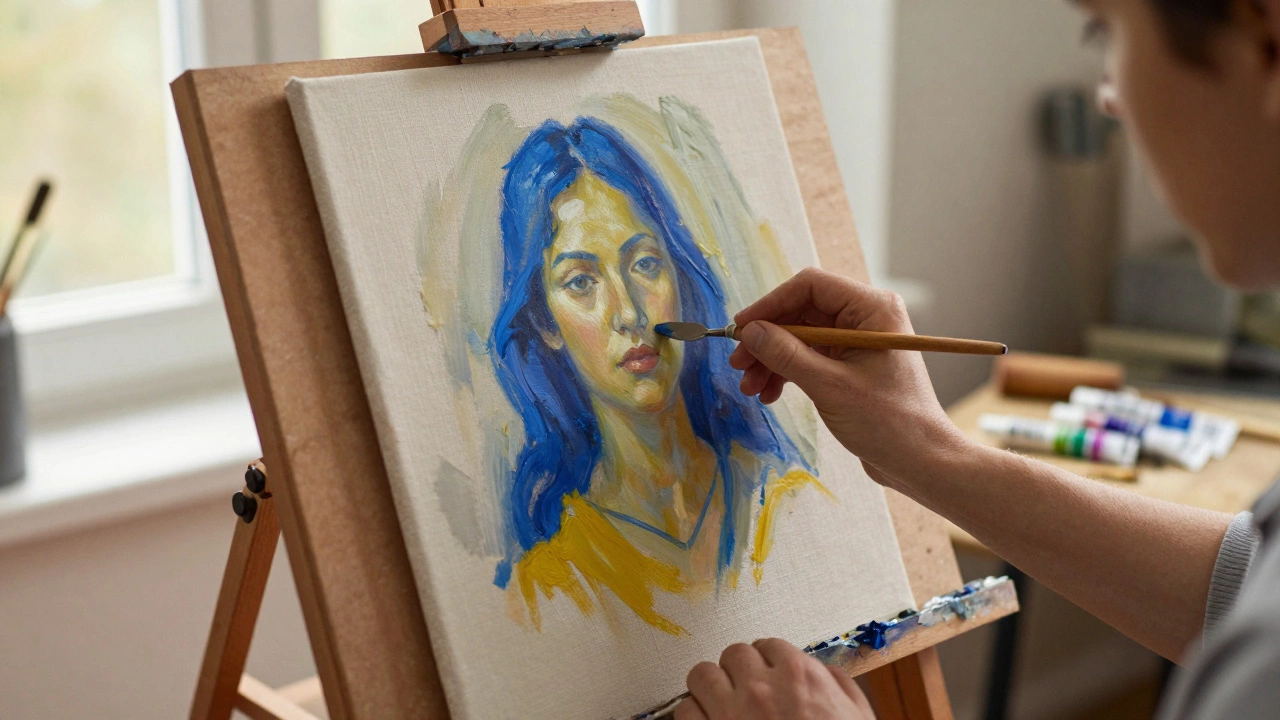
What you’ll find below isn’t a textbook. It’s real talk from artists and collectors who’ve lived this. You’ll see how painter terminology shows up in today’s art—from the thick layers in a modern oil portrait to the digital tricks that mimic brushstrokes. You’ll learn why some paintings crack over time, why varnish matters, and how the same color can feel totally different depending on the medium. This isn’t about memorizing definitions. It’s about seeing art with new eyes.
4 Dec 2025
A portrait painter is an artist who specializes in painting human faces and figures, capturing not just likeness but personality. The term has deep historical roots, from court painters to limners. Today, portrait painters still create meaningful, hand-crafted works that photographs can't replicate.
Continue reading...