Contemporary Art Style Identifier
Answer 5 questions to identify which characteristics define contemporary art. Based on the latest trends discussed in our article.
Your Contemporary Art Profile
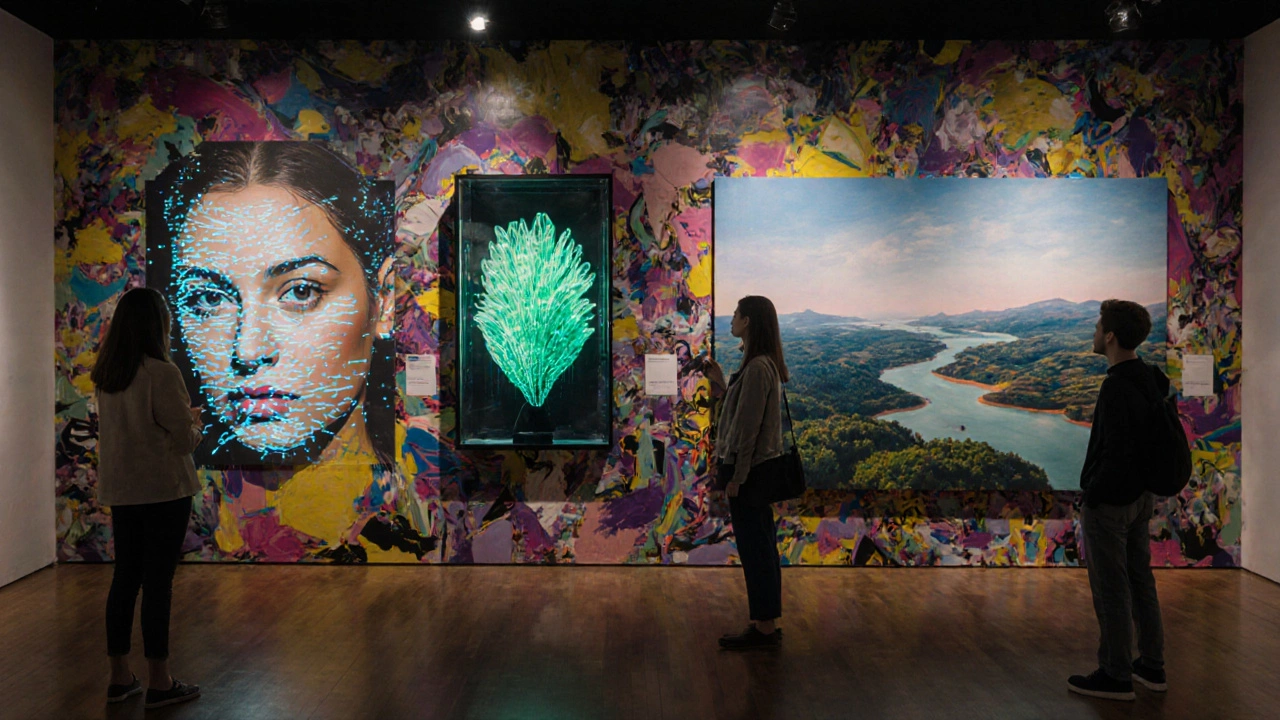
There’s no single name for today’s art style-because there isn’t one. If you’re asking what the current art style is called, you’re not alone. Walk into any major gallery in New York, Berlin, or even Wellington, and you’ll see wildly different things: hyperrealistic portraits next to glitchy digital collages, hand-painted abstracts beside AI-generated landscapes. It’s messy. It’s loud. And it’s completely normal.
There’s No Unified Style Anymore
Back in the 1960s, you could point to Pop Art or Minimalism and say, ‘That’s what’s happening now.’ In the 2000s, it was Neo-Expressionism or Conceptual Art. But today? The rules dissolved. Artists don’t wait for movements to be named-they just make what feels true to them. And the public follows what moves them, not what fits a label.
Think of it like music. You don’t call all music released in 2025 ‘pop’ just because it’s on the charts. Some tracks are lo-fi hip-hop, others are hyperpop, others are field recordings of rain in Bali. Art works the same way now. The internet made it impossible for one style to dominate. You can be inspired by 18th-century Japanese woodblock prints and still make a video piece using real-time AI rendering. That’s not a contradiction-it’s the new normal.
What You’re Actually Seeing Right Now
If you had to name the most visible trends in 2025, here’s what you’d find:
- Digital hybridization-paintings that start as AI prompts, get printed on canvas, then hand-painted over with oil or acrylic. Artists like Tabor Robak and Refik Anadol pioneered this, but now it’s everywhere-from boutique galleries to Airbnb walls.
- Emotional realism-figures with distorted proportions, exaggerated expressions, and surreal lighting. Think of artists like Jenny Saville or Kehinde Wiley, but younger. Their work doesn’t just show a person-it shows how that person feels under pressure, isolation, or joy.
- Material experimentation-artists are using everything from recycled plastic waste to bioluminescent algae. In Wellington, a recent show featured sculptures made from discarded fishing nets collected from the Tasman Sea.
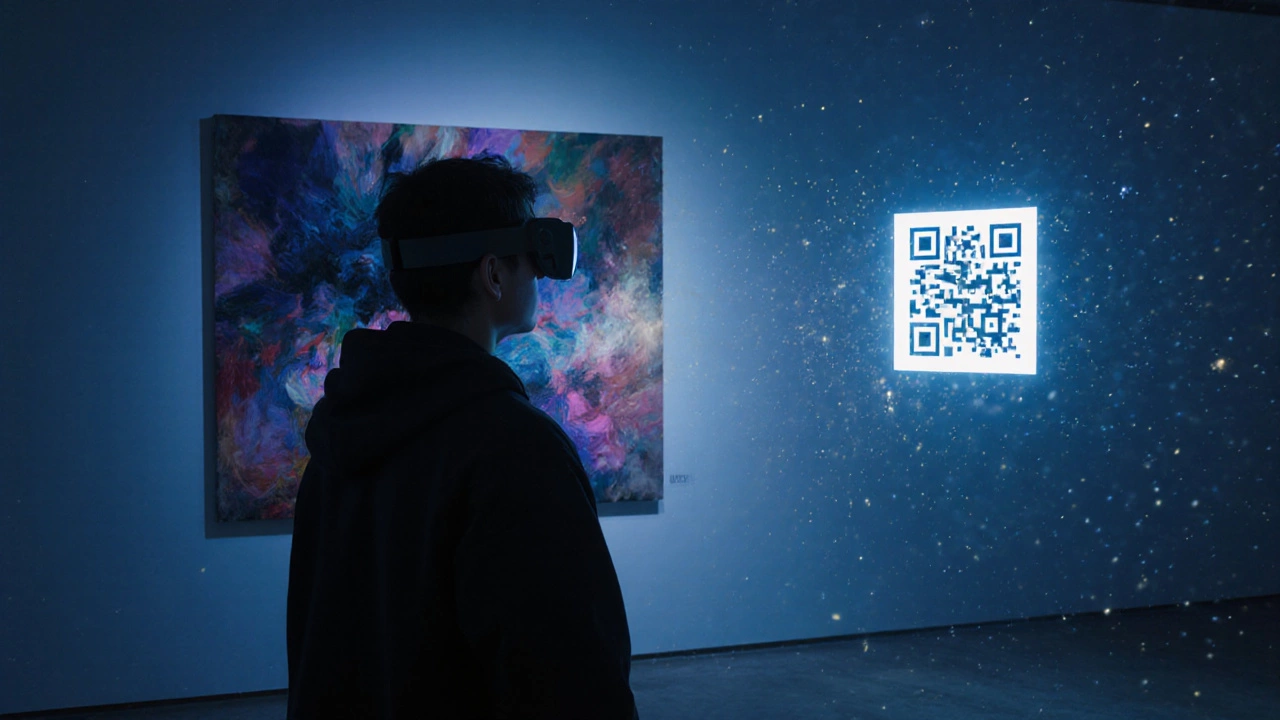
- Decentralized storytelling-instead of one central narrative, artworks now invite multiple interpretations. You might scan a QR code on a painting and get a poem, a voice recording, or a live stream from the artist’s studio.
None of these are movements. They’re tools. And artists pick them like ingredients in a kitchen.
Why ‘Modern Art’ Doesn’t Cut It Anymore
People still say ‘modern art’ when they mean ‘art from the last 50 years.’ But that’s wrong. Modern Art-capital M, capital A-refers to a specific period: roughly 1860 to 1970. It includes Picasso, Matisse, Pollock, and Duchamp. It had clear goals: breaking from tradition, exploring form, rejecting realism.
What we have now is Contemporary Art. That’s the official term used by museums, critics, and auction houses. It doesn’t mean ‘current’ in a trendy way-it means art made after 1970, by artists alive today, responding to our world. And that world includes climate anxiety, digital identity, global migration, and the collapse of traditional institutions.
So if you need one label, use ‘Contemporary Art.’ But don’t expect it to tell you what the art looks like. It won’t. It only tells you when it was made-and who made it.
The Role of Technology Is No Longer Optional
AI isn’t just a tool-it’s a collaborator. In 2025, nearly 60% of emerging artists use generative AI at some stage of their process, according to a survey by the International Association of Contemporary Art. But here’s the catch: they’re not using it to replace skill. They’re using it to break out of their own habits.
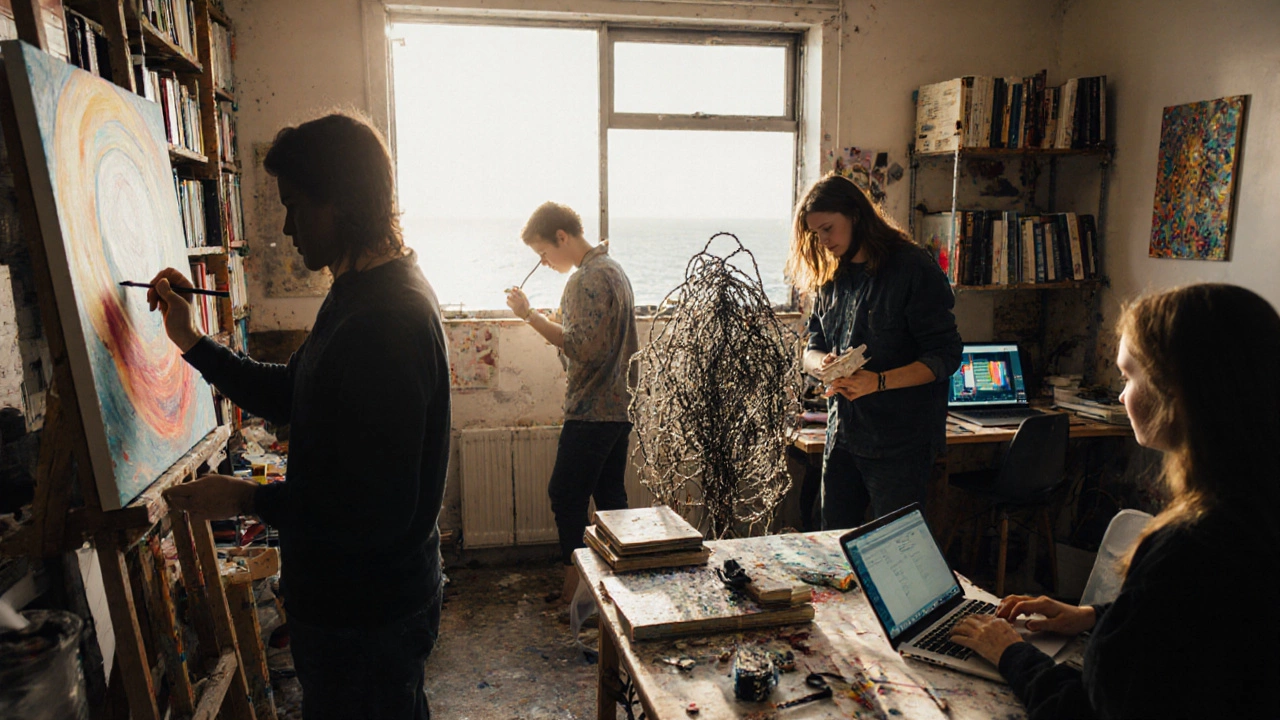
One artist in Melbourne told me she feeds her own sketches into an AI model, then picks the weirdest outputs and paints them by hand. Another in Toronto uses AI to analyze 10,000 historical portraits and generates new facial expressions no human could imagine. The result? Art that feels both ancient and alien.
And it’s not just AI. Augmented reality is now common in galleries. You put on glasses or open an app, and a sculpture starts moving. A painting breathes. A mural changes color based on your heartbeat. The line between viewer and participant is gone.
What’s Missing? The Grand Narratives
One of the biggest shifts in contemporary art is the absence of a unifying ideology. In the 1970s, feminist art, political protest, and identity politics gave movements direction. Today, those concerns are still present-but they’re scattered. You won’t find a manifesto for ‘2025 Art.’ There’s no group declaring, ‘We all believe in X.’
Instead, you get micro-communities. A group of artists in Lagos focus on ancestral memory through textile art. A collective in Seoul uses data from air quality sensors to create soundscapes. A teenager in Buenos Aires posts glitched self-portraits on Instagram that get 200,000 likes. None of them know each other. But they’re all part of the same cultural moment.
This fragmentation isn’t weakness-it’s strength. It means art is more diverse, more personal, more honest.
How to Recognize Contemporary Art When You See It
You don’t need to know the name of the style. You just need to ask yourself three questions:
- Does it feel like it was made for right now? Not nostalgic. Not trying to copy the past. Does it react to the world as it is-fast, uncertain, digital, anxious?
- Is it made with intention, not just technique? A beautiful painting isn’t enough. Contemporary art asks: Why this? Why now? Why this material? Why this form?
- Does it leave space for you? Does it invite you in? Make you think? Challenge your assumptions? Or does it just sit there, pretty but empty?
If the answer to all three is yes, you’re looking at contemporary art-even if it looks like a child’s crayon drawing or a robot’s scribble.
Why This Matters
Art doesn’t exist to be labeled. It exists to reflect us. And right now, we’re messy. We’re connected but lonely. We’re powerful but powerless. We’re drowning in information but starved for meaning.
Contemporary art doesn’t give you answers. It gives you mirrors. And that’s why it’s more important than ever.
Is contemporary art the same as modern art?
No. Modern Art refers to work created between roughly 1860 and 1970, led by artists like Picasso and Mondrian. Contemporary Art is everything made after 1970 by living artists. Modern Art broke from tradition. Contemporary Art lives inside today’s chaos.
Can AI-generated art be considered real art?
Yes-if a human guides it. AI doesn’t decide what to make, why to make it, or how to edit it. Artists use AI as a brush, not a painter. The value comes from the human intention behind the selection, refinement, and context. Galleries and collectors treat AI-assisted art the same as any other medium now.
Why does contemporary art look so weird sometimes?
It’s not weird-it’s honest. We live in a world of contradictions: hyper-connected yet isolated, overloaded yet numb. Contemporary art mirrors that. Distorted faces, chaotic compositions, and strange materials aren’t meant to shock-they’re meant to match how we feel.
Is there a market for contemporary art?
Yes, and it’s growing. In 2024, global sales of contemporary art exceeded $18 billion, according to Art Basel and UBS’s annual report. The biggest buyers aren’t just billionaires-they’re young collectors, tech workers, and even public institutions looking to reflect their communities.
How do I start collecting contemporary art?
Start small. Look at local art schools, pop-up galleries, or online platforms like Artsy or Saatchi Art. Buy what moves you, not what’s trendy. Many artists sell work for under $500. The key is to connect with the artist’s story-not just the object.
Where to Look Next
If you want to see what’s happening now, skip the big museums for a moment. Go to small artist-run spaces. Follow Instagram accounts tagged #contemporaryartnz or #emergingartists. Check out university grad shows-they’re where the next big names start. In Wellington, the Adam Art Gallery and The Physics Room regularly feature work that’s raw, real, and unfiltered.
You don’t need to understand it. You just need to feel it.