Art Exhibition Knowledge Quiz
How Well Do You Know Art Exhibitions?
Test your understanding of what goes into an art exhibition. Answer the questions based on the article content.
Ever walked into an art exhibition and felt overwhelmed-not by the art, but by everything else? You see paintings, sculptures, maybe videos or installations, but what holds it all together? An art exhibition isn’t just a room full of stuff on walls. It’s a carefully built experience. Here’s what actually goes into one.
The Artworks Themselves
This is the obvious part, but it’s also the most complex. An exhibition doesn’t just throw up any artwork. Each piece is chosen because it speaks to the theme, the artist’s intent, or the curator’s argument. You might see oil paintings, bronze sculptures, digital projections, textile works, or even performance art captured on video. The variety matters. A show of 19th-century landscapes won’t include a hologram unless it’s making a deliberate point. The selection is intentional. For example, the 2024 Wellington Biennial featured 87 works from 42 artists across 12 countries, all tied to the theme of coastal erosion and cultural memory. Every object had a reason to be there.
Curation and Narrative
Curators are the unseen storytellers. They don’t just pick art-they build a journey. Think of it like a book with chapters. One room might introduce the artist’s early work. Another shows a turning point. A third might contrast their style with another artist’s. The order matters. A painting of a broken clock might come after a series of clocks ticking in unison, creating a quiet moment of tension. Curators work with museums, galleries, and private collectors to borrow pieces. Sometimes, they commission new work. The 2023 Auckland Art Gallery show on Māori textile traditions included five newly woven kākahu (traditional cloaks) made specifically for the exhibition, blending ancestral techniques with contemporary design.
Exhibition Design and Layout
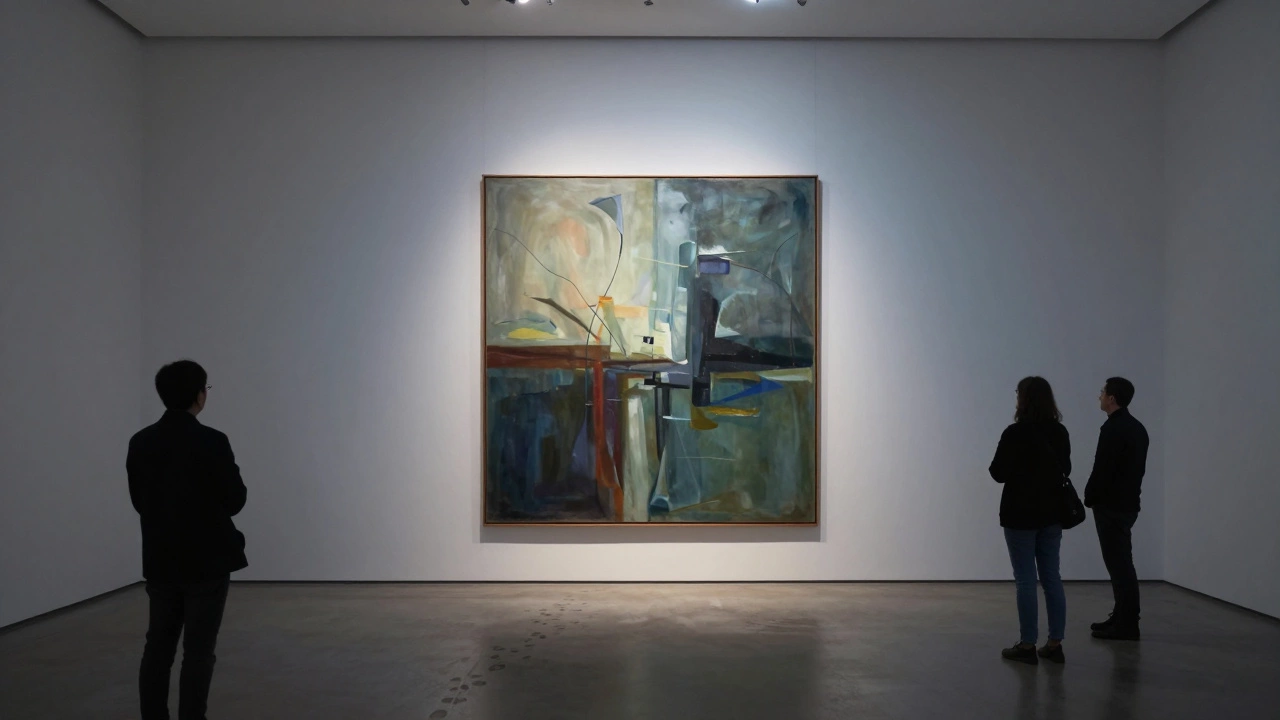
How you move through the space shapes how you feel about the art. Wide hallways? You feel calm. Narrow, dimly lit corridors? You feel intimate-or uneasy. Lighting isn’t just functional. A spotlight on a single sculpture can make it feel sacred. Soft ambient light on a wall of photographs invites you to linger. The height of hanging pieces? It’s not random. Eye level is usually 145 cm from the floor-that’s the average viewer’s sightline. If a piece is too high or too low, it’s a choice. A 2025 show at the City Gallery in Wellington hung several large abstract canvases from the ceiling to force viewers to look up, creating a sense of awe. Even the color of the walls matters. White is common, but deep navy or charcoal can make colors pop differently.

Labels and Interpretive Text
Those small cards next to the art? They’re not filler. A good label gives you just enough: the artist’s name, title, year, medium, and sometimes a line or two about context. “Oil on canvas, 1982” tells you the material. “Inspired by the 1979 earthquake in Wellington” tells you the story. Some exhibitions skip text entirely, trusting the art to speak. Others use QR codes linking to audio guides or video interviews. The Museum of Contemporary Art in Sydney now includes tactile labels for visually impaired visitors, with raised outlines of the artworks. That’s part of inclusion-not an afterthought.
Lighting, Climate, and Security
Art is fragile. UV light fades pigments. Humidity warps wood and canvas. Temperature swings crack varnish. Exhibition spaces have climate control systems that maintain 20-22°C and 45-55% humidity-exactly what’s recommended by the International Council of Museums. Lighting uses LED filters to block UV rays. Security isn’t just cameras. It’s motion sensors, glass cases, and staff trained to notice if someone lingers too long in front of one piece. In 2024, a small ink drawing in a London show was protected by a glass case with a built-in humidity sensor that sent alerts if conditions changed by even 1%.
Public Programs and Events
Exhibitions aren’t static. Many include guided tours, artist talks, workshops, or film screenings. A show on indigenous land rights might include a panel with elders. A digital art exhibit might host a coding workshop for teens. These events turn passive viewing into active engagement. The Te Papa museum in Wellington added a weekly “Sketch & Talk” session during its 2025 exhibition on Pacific navigation, where visitors drew their own maps while listening to oral histories. Attendance jumped by 40% in the first month.
Accessibility and Inclusion
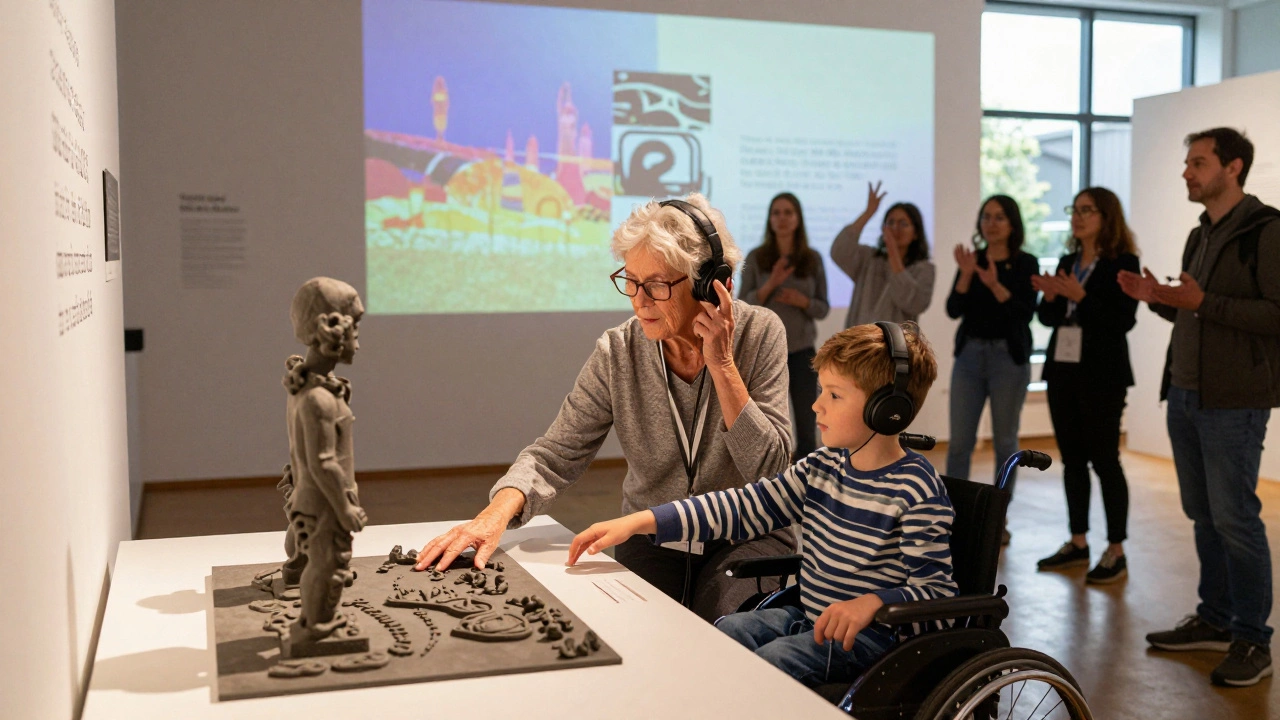
Modern exhibitions don’t just welcome viewers-they design for them. Ramps instead of stairs. Audio descriptions for blind visitors. Sign language tours. Sensory-friendly hours with lowered lights and reduced sound. Some galleries now offer tactile models of sculptures, or apps that describe scenes in real time. A 2025 exhibition at the Christchurch Art Gallery included a version of every wall text in plain language, Braille, and te reo Māori. It’s not about being politically correct-it’s about making the art accessible to everyone who wants to see it.
Documentation and Archiving
When the exhibition closes, the work doesn’t vanish. Photographs are taken. Installation notes are written. Labels are scanned. Videos of opening nights are archived. This isn’t just for the gallery’s records-it’s for future researchers, students, or even the artists themselves. The Auckland Art Gallery’s digital archive now holds over 1,200 exhibition records dating back to 1951. Someone studying how Māori art was presented in the 1980s can pull up those old catalogs and see how curation has changed.
What’s Missing? The Visitor
Here’s the thing: no matter how perfect the lighting, the labels, or the climate control, the exhibition isn’t complete without you. Your pause in front of a painting. Your quiet gasp at a sculpture. Your conversation with a friend about what it meant. That’s the final layer. The art speaks. The curation guides. But you complete it. That’s why the best exhibitions don’t just show you something-they leave you changed.
Do all art exhibitions include sculptures?
No. Art exhibitions can include any medium: paintings, photographs, videos, installations, textiles, performance recordings, or even scent-based works. The choice depends entirely on the theme. A show focused on digital identity might feature only screen-based works. A historical exhibition on 18th-century portraiture might include only oil paintings and drawings. Sculpture is common, but not required.
How long do art exhibitions usually last?
Most last between 3 to 6 months. Smaller gallery shows might run for 4-8 weeks. Major museum exhibitions, especially ones that travel internationally, can last up to a year or more. For example, the 2024 Venice Biennale ran for 6 months, while a solo show at a regional gallery might only be on view for 6 weeks. The duration depends on the size of the collection, the number of venues, and the complexity of installation.
Can I take photos in an art exhibition?
It depends. Many galleries allow non-flash photography for personal use, but some restrict it to protect light-sensitive works like watercolors or textiles. Others ban photography entirely to preserve the atmosphere or because of copyright restrictions. Always check signs at the entrance or ask staff. Some exhibitions, especially those with digital or interactive elements, encourage photos and even social media sharing.
Are all artworks in an exhibition for sale?
No. Many exhibitions are purely for display and education. Even in commercial galleries, some pieces are loaned from museums or private collections and are not for sale. If you’re interested in buying, ask for a catalog or speak to gallery staff-they’ll tell you which works are available. The price list is often kept separate from the exhibition itself.
What’s the difference between a museum exhibition and a gallery exhibition?
Museum exhibitions are usually non-commercial, research-driven, and focus on historical context, education, or cultural preservation. They often borrow from multiple institutions and include extensive interpretive materials. Gallery exhibitions-especially commercial ones-are often focused on selling work by living artists. They’re shorter, more stylistically focused, and tied to current market trends. But the line is blurring: many museums now show contemporary art, and some galleries host scholarly talks.