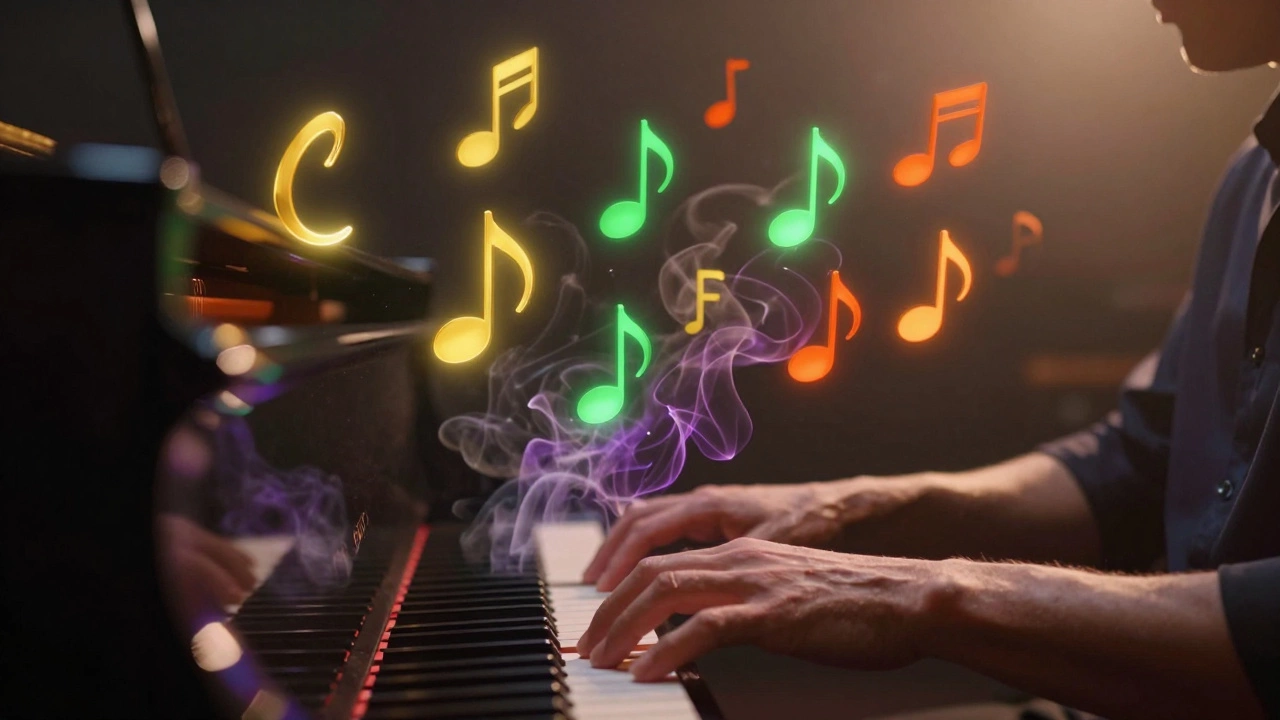
When you hear a trumpet blast, do you see red? Does a cello’s low note feel like deep blue velvet? If so, you’re not alone - and you’re not imagining things. Color in music isn’t just a poetic metaphor. It’s a real, measurable experience for some people, and a powerful tool for composers, producers, and listeners alike.
What Does ‘Color’ Really Mean in Music?
Unlike visual art, music doesn’t have literal pigments. But musicians and listeners have long used the word ‘color’ to describe the unique texture, brightness, or warmth of a sound. This isn’t poetry - it’s a shorthand for timbre, the quality that lets you tell a violin from a flute, even when they play the same note.
Think of it this way: two pianos playing middle C. One sounds bright and crisp, like a new Steinway. The other feels muffled, like an old upright with worn hammers. That difference? That’s color. It’s shaped by the instrument’s materials, how it’s played, the room it’s in, and even the musician’s touch.
Producers use this all the time. A bass guitar with a warm, rounded tone might be called ‘brown’ in the studio. A high-hat with a sharp, metallic ring? That’s ‘silver.’ A synth pad that feels like fog rolling over a lake? That’s ‘gray.’ These aren’t just whimsical labels - they guide mixing decisions, effects, and arrangement choices.
Why Do People ‘See’ Music?
For about 4% of the population, hearing music literally triggers visual experiences. This is called chromesthesia, a form of synesthesia where sound involuntarily evokes color. A 2023 study from the University of Auckland found that people with chromesthesia consistently associate the same notes with the same colors - C major often feels like yellow, D minor like deep green, and F# minor like burnt orange.
One musician in the study, a jazz pianist from Wellington, described how a G7 chord always appeared as swirling copper and violet smoke. She didn’t realize others didn’t see it until her teacher asked, ‘Why are you drawing rainbows while you play?’
These associations aren’t random. They often form early in life, tied to emotional memories or even the shape of musical notation. For some, the color of a note changes with its volume - a soft A might be pale pink, but a loud A bursts into crimson.
How Composers Use Color to Shape Emotion
You don’t need synesthesia to use color in music. Composers have been doing it for centuries.
Maurice Ravel’s Jeux d’eau doesn’t just sound like water - it’s written to feel like it. The high, sparkling arpeggios? That’s liquid silver. The deep, rippling bass notes? That’s dark, flowing indigo. Ravel didn’t just write notes - he painted with sound.
Debussy used whole-tone scales to create a hazy, dreamlike atmosphere - what he called ‘the color of mist.’ Stravinsky’s The Rite of Spring uses clashing brass and pounding percussion to evoke earthy browns, burnt umber, and blood-red urgency.
Modern film composers do the same. Hans Zimmer’s low cello drones in Inception aren’t just haunting - they’re described by fans as ‘thick, tar-black’ tones. The high, shimmering strings in Interstellar? That’s the color of cold, starlit space: pale blue and silver.
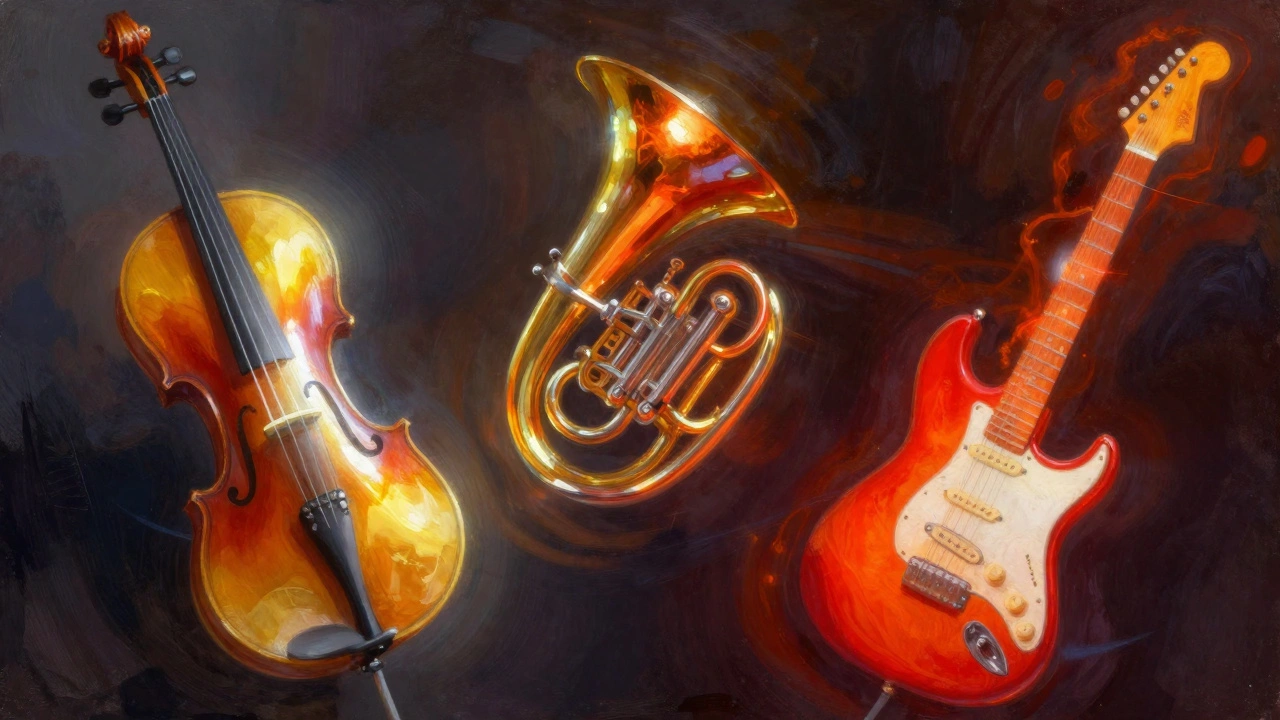
Instrument Choice = Color Palette
Each instrument brings its own palette.
- Violin: Bright gold, sometimes sharp white - especially in the upper register.
- French horn: Warm bronze, like a sunset seen through amber glass.
- Clarinet: Soft amber or honeyed brown - smooth and slightly muffled.
- Electric guitar with distortion: Electric neon red or hot orange - aggressive, vibrating.
- Acoustic guitar: Sun-bleached beige or light tan - natural, grounded.
- Church organ: Deep, dusty gold with streaks of purple - sacred, echoing.
Even the same instrument can shift color. A saxophone played softly in a ballad feels like smoked glass - cool, muted, translucent. Played with force in a jazz solo? It turns into molten copper, glowing and loud.
How to Train Your Ears to Hear Color
You don’t have to be born with synesthesia to start noticing color in music. Here’s how to tune in:
- Listen to a single note - say, a piano C. Close your eyes. What color comes to mind? Don’t think. Just feel.
- Play the same note on different instruments. Does the color change? A C on a cello feels heavier than a C on a piccolo.
- Listen to a chord progression. Try assigning a color to each chord. Does the V chord feel brighter than the I? Does the minor iv chord turn the room gray?
- Try this with songs you love. Pick one track. Pause it every 10 seconds. What color is the sound right now? Write it down.
- Notice how effects change color. Reverb adds haze - maybe a soft gray. Distortion adds heat - red or orange. Delay creates echoes that might feel like fading blue.
After a few weeks, you’ll start hearing music differently. Not just as notes and rhythms - but as a living palette.

Color in Music Production
Producers don’t just mix levels - they mix color.
Want a track to feel warm and intimate? Roll off the high end. Add subtle tape saturation. That’s adding ‘brown’ - the color of old vinyl, of a cozy room.
Want it to feel futuristic? Boost the 8-12 kHz range. Add a shimmering delay. That’s ‘silver’ or ‘electric white.’
Many engineers use color-based terms in session notes:
- ‘Too much blue’ = too many highs, harsh.
- ‘Needs more red’ = needs more midrange energy, punch.
- ‘It’s too gray’ = lifeless, flat, no dynamics.
One producer in Berlin told me he once mixed an entire album using only color references: ‘The bridge should feel like a violet mist. The chorus? A burst of gold lightning.’ His client didn’t know what he meant - but when they heard it, they cried. They knew exactly what he meant.
Why This Matters for Listeners
Understanding color in music turns passive listening into active discovery. You stop just enjoying a song - you start seeing it.
That’s why some people return to the same album for years. It’s not just the melody or lyrics - it’s the emotional landscape it paints. A rainy Tuesday might call for a song with cool blues and muted greens. A celebration? Bright yellows, hot pinks, electric teal.
Artists like Björk, Prince, and Radiohead build entire sonic worlds using color. Their albums aren’t just collections of songs - they’re immersive paintings you can walk through.
When you learn to hear color, music stops being background noise. It becomes something you feel in your bones, see in your mind, and carry with you long after the last note fades.
Can You Teach Someone to Hear Color?
Yes - but not by forcing it. You can’t make someone with no synesthesia suddenly see red when they hear a D#.
But you can train your brain to associate sounds with feelings, textures, and visual metaphors. That’s not synesthesia - it’s heightened perception. And it’s just as powerful.
Try this: next time you hear a song, ask yourself: ‘If this sound had a texture, what would it feel like?’ Velvet? Sandpaper? Ice? Rain? That’s your brain translating sound into sensory language. That’s color.
There’s no right or wrong answer. Your color for a minor chord might be purple. Mine might be charcoal. That’s okay. What matters is that you feel it.
Is color in music just a metaphor?
No - while it’s often used metaphorically, for people with chromesthesia, it’s a real neurological experience. Even for others, the concept of color helps describe timbre, emotional tone, and sonic texture in ways that technical terms like ‘frequency spectrum’ cannot.
Do all instruments have fixed colors?
No. An instrument’s color changes based on how it’s played, the room acoustics, the amplifier settings, and even the musician’s mood. A trumpet can sound bright gold in a jazz solo or warm bronze in a ballad. Color is fluid, not fixed.
Can digital synths have color?
Absolutely. A sine wave might feel clear and white. A sawtooth wave can be harsh and red. Analog-style synths often have a warm, brownish tone, while digital FM synths can sound icy or metallic. Sound design is color design.
Why do minor keys sometimes feel darker?
Minor keys often have lower harmonic energy and more dissonant intervals, which our brains associate with shadows, depth, or stillness. That’s why they’re often described as gray, blue, or deep purple - not because of the notes themselves, but because of the emotional space they create.
Can color in music be measured scientifically?
Not directly - you can’t put a color meter on a violin. But researchers can map how people consistently describe sounds, and use fMRI to see which brain areas activate during synesthetic experiences. The patterns are real, even if the color isn’t visible to others.